Art and Art History Collection (Saskia)
The Art and Art History Collection from Saskia Ltd., Cultural Documentation features a wide range of digital images with an emphasis on the history of Western art. There are 3,645 images in this collection. Image sets include: The Dresden Collection, Brueghel and Rubens, Ancient Greek Art (Architecture and Sculpture), Ancient Art (Minoan and Roman), Roman Art, Michelangelo, Italian Renaissance, Realism, Impressionism, Post-Impressionism, and Contemporary Architecture. Images from art history textbooks include: Gardner, Expanded Gardner, Stokstad, Gilbert, Hartt, Cunningham, and Reich.
Access note: Only thumbnail images and descriptive information are available to non-USF users. Full access to this collection is available only to authorized users on the USF network on campus or via VPN. For more information or to report technical issues please contact us.
-
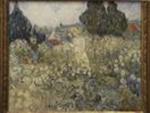
Dr. Gachet's Daughter in Garden at Auvers-sur-Oise
Unknown
In pure, expressive colors the lovely scene is of Marguerite Gachet in her father's garden. Dr. Gauchet treated the painter during his nervous breakdown.
-
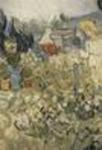
Dr. Gachet's Daughter in Garden at Auvers-sur-Oise (detail)
Unknown
In pure, expressive colors the lovely scene is of Marguerite Gachet in her father's garden. Dr. Gauchet treated the painter during his nervous breakdown.
-
Dr. Gachet's Garden (detail) Dr. Gachet's Garden at Auvers-sur-Oise
Unknown
In May 1890 Vincent visited Theo and his family in Paris and then settled in Auvers-sur-Oise, near Paris. The town was chosen because Dr. Gachet, himself a hobby painter and friend of the Impressionists, was living there, he agreed to take care of Vincent. In Auvers van Gogh painted more than 80 pictures. During these last weeks of his life it was only due to his work that he could forget about his illness, and he painted as if possessed.
-
Dr. Gachet's Garden Dr. Gachet's Garden at Auvers-sur-Oise
Unknown
In May 1890 Vincent visited Theo and his family in Paris and then settled in Auvers-sur-Oise, near Paris. The town was chosen because Dr. Gachet, himself a hobby painter and friend of the Impressionists, was living there, he agreed to take care of Vincent. In Auvers van Gogh painted more than 80 pictures. During these last weeks of his life it was only due to his work that he could forget about his illness, and he painted as if possessed.
-
Duke and Duchess of Urbino Reverse: Triumphal Procession Allegorical Triumph of Federico da Mantefeltro and Portrait of Federico da Montefeltro, Duke of Urbino
Unknown
On the front the two panels show profile portraits of Federico da Montefeltro, Duke of Urbino, and his wife, Battista Sforza. The reverse shows allegorical representations of their virtues. During the 1460s the artist worked for the Duke of Urbino, for whom he executed the Flagellation of Christ and the Senigallia Madonna, the wonderful twin portrait of the Duke and his wife Battista Sforza (Florence, Uffizi), the Nativity, and above all the incomparable Pala Montefeltro, which by some critics is considered to be his best work, which epitomizes the noblest aspirations of Early Renaissance.
-
Dutch Landscape Viewed from the Dunes
Unknown
Koninck's development had stopped in the middle of the seventeenth century, he would be remembered as a talented Rembrandt follower. But from about 1649-50 until around 1665 he created a series of very large panoramic views in a distinctive personal style. They are closely related to the classical phase of Dutch landscape painting and are amongst the great glories of Dutch art.
-
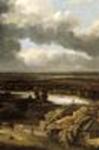
Dutch Landscape Viewed from the Dunes (detail)
Unknown
Koninck's development had stopped in the middle of the seventeenth century, he would be remembered as a talented Rembrandt follower. But from about 1649-50 until around 1665 he created a series of very large panoramic views in a distinctive personal style. They are closely related to the classical phase of Dutch landscape painting and are amongst the great glories of Dutch art.
-
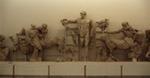
East Pediment of the Temple of Zeus at Olympia
Unknown
Overall view of central portion (up to horse on right side)
-
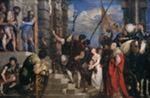
Ecce Homo
Unknown
During the 1540s, the compositional principles of Mannerism can be found in Titians work. The painting "Ecce Homo (dated 1543) comes from this brief period. Influenced by Michelangelo and his circle in Florence and Rome, Titian assumes their predilection for asymmetric composition. The treatment advances rapidly from lower right to upper left, and the main figure of Christ is found, amazingly enough, not in the centre as was customary but at the outermost edge of the canvas. Additional Mannerist devices may be seen here in the vigorous movement motifs and the uneven use of color, sometimes dull and then again aggressive.
-
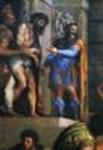
Ecce Homo (detail)
Unknown
The main figure of Christ is found not in the centre as was customary but at the outermost edge of the canvas. Additional Mannerist devices may be seen here in the vigorous movement motifs and the uneven use of color, sometimes dull and then again aggressive. The painting was conceived for the city palace (on the Grand Canal) of the Flemish businessman Giovanni dAnna (actually, van Haanen). This explains the pictures theme, rarely found in Italy but highly regarded in the North. Depicted is the dramatic and portentous scene (John 19:4-16) in which Pontius Pilate, the Roman procurator of Jerusalem, leads Christ, after his questioning and scourging, before the masses and says, "Ecce homo! (Behold the man!) and offers his release.
-
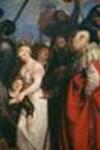
Ecce Homo (detail)
Unknown
Pontius Pilate, the Roman procurator of Jerusalem, leads Christ, after his questioning and scourging, before the masses and says, "Ecce homo! (Behold the man!) and offers his release. The masses, however, demand his crucifixion. Within the pictorial setting of the ancient Roman Empire, Titian mixes time periods together by introducing the current Habsburg imperial house into the scene. (He had been their titled court painter since 1533.) The double eagle on the shield and next to it the addition to the signature of eques ces(aris) imperial knight were signs of homage paid by Titian to his Habsburg sovereigns.
-
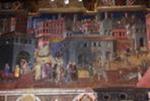
Effects of Good Government on the City Life (detail) Allegories of Good and Bad Government and the effects of good and bad government
Unknown
The Effect of the Good Government is situated on the longer wall of the room. This panoramic fresco represents several scenes indicating the life of Siena and its environment in the 14th century. This detail shows the center of the city. In the middle the dancing young women probably represent the nine Muses. There are several genre like scenes in the picture (shops, chatting men, riders, working men on the roof etc.)
-
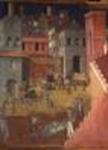
Effects of Good Government on the City Life (detail) Allegories of Good and Bad Government and the effects of good and bad government
Unknown
The Effect of the Good Goverment is situated on the longer wall of the room. This panoramic fresco represents several scenes indicating the life of Siena and its environment in the 14th century. This detail shows the centre of the city. In the middle the dancing young women probably represent the nine Muses. There are several genre like scenes in the picture (shops, chatting men, riders, working men on the roof etc.).
-
Effects of Good Government on the Countryside (detail) Allegories of Good and Bad Government and the effects of good and bad government
Unknown
The countryside around Siena is the setting for farming, trade and hunting scenes.
-
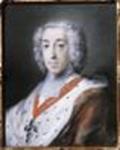
Elector Clemens August of Cologne
Unknown
Rosalba Carriera was a Venetian woman pastellist who had a great vogue in Venice, chiefly among British tourists, in Paris (1720-21), and Vienna (1730). She painted snuff boxes for the tourist trade with miniatures on ivory, a technique she seems to have pioneered as against the earlier use of card as a ground. She was painting miniatures by 1700, and her earliest pastels are of c. 1703. In 1705 she was made an 'accademico di merito' by the Accademia di San Luca in Rome, a title reserved for non-Roman artists. She achieved immense popularity, and made pastel portraits of notabilities from all over Europe.
-
Elector Clemens August of Cologne (detail)
Unknown
Rosalba Carriera was a Venetian woman pastellist who had a great vogue in Venice, chiefly among British tourists, in Paris (1720-21), and Vienna (1730). She painted snuff boxes for the tourist trade with miniatures on ivory, a technique she seems to have pioneered as against the earlier use of card as a ground. She was painting miniatures by 1700, and her earliest pastels are of c. 1703. In 1705 she was made an 'accademico di merito' by the Accademia di San Luca in Rome, a title reserved for non-Roman artists. She achieved immense popularity, and made pastel portraits of notabilities from all over Europe.
-
Equestrian Emperor Charles V at M Emperor Charles V at M
Unknown
Titian took inspiration for the equestrian arrangement of this piece from classic antiquity. It shows the Emperor of the Holy Roman-Germanic Empire as an inspiring symbol of power. It commemorates the battle of Muehlberg, which took place against the protestant troops of John Frederick of Saxony. Titian uses the technique of painting in heavy, dark colors, and emphasized the harsh and noble character of this person. Undoubtedly, a masterpiece.
-
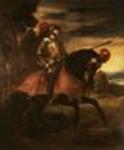
Equestrian Emperor Charles V at M Emperor Charles V at M
Unknown
This portrait commemorates the battle of M
-
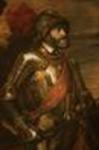
Equestrian Emperor Charles V at M Emperor Charles V at M
Unknown
This is one of Titian's most dramatic and monumental portraits, conveying not so much the personality of the sitter as the high ideals of his imperial office. At the Battle of M
-
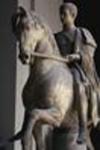
Equestrian Figure of Marc Antonio Balbo, Proconsul of Herculaneum
Unknown
Horse and rider from front right
-
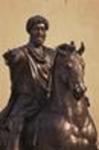
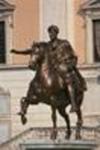
Equestrian Monument to Marcus Aurelius (r. 161-180)
Unknown
Close frontal view of horse and rider (1998)
-
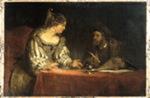
Esther and Mordecai
Unknown
Aert de Gelder was one of Rembrandt's last pupils and continued to work in the spirit and style of his master long after other pupils, for instance, Maes, Gerbrand van den Eeckhout and Jan Lievens, had succumbed to the fashionable trend towards smooth and perfunctory painting. Like his master, he loved rich properties and colorful draperies, his studio was a veritable gallery of antiques, full of ancient weapons, silks and all kinds of utensils, and he used manikins for the sake of greater authenticity, carefully dressing them to suit the requirements of his theme. He painted with broad strokes of the brush, as Rembrandt had, and created warm tonalities and color harmonies.
-
Esther and Mordecai (detail)
Unknown
Aert de Gelder was one of Rembrandt's last pupils and continued to work in the spirit and style of his master long after other pupils, for instance, Maes, Gerbrand van den Eeckhout and Jan Lievens, had succumbed to the fashionable trend towards smooth and perfunctory painting. Like his master, he loved rich properties and colorful draperies, his studio was a veritable gallery of antiques, full of ancient weapons, silks and all kinds of utensils, and he used manikins for the sake of greater authenticity, carefully dressing them to suit the requirements of his theme. He painted with broad strokes of the brush, as Rembrandt had, and created warm tonalities and color harmonies.
-
Esther and Mordecai (detail)
Unknown
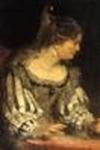
Esther and Mordecai, is one of de Gelder's most valuable and characteristic works. The Old Testament book of Esther is summarized here into a single dramatic moment, the internal tension being conveyed through the structure of the composition and through the gestures. The painting depicts the scene of the Biblical story when Mordecai, foster-father of Esther persuades the Queen to induce her husband to save the Jewish people. De Gelder painted several versions of this subject differing in various degrees; the version now in the Providence Museum of Art, Rhode Island, also depicting half-length figures, is particularly close to the painting in Budapest.
-
Esther before Ahasver Estherand Ahasver
Unknown
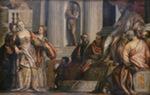
This picture illustrates the Old Testament story of the Jewish Queen Esther who appeared, unbidden, before King Ahasuerus, risking his disfavor to plead for her people. To prepare herself, Esther fasted for three days, and artists usually showed her in a swoon to underscore her emotional state of mind. Paolo Veronese was one of the great masters of the Venetian school. Originally named Paolo Caliari, he was called Veronese from his native city of Verona. Although highly successful, he had little immediate influence, the Flemish baroque master Peter Paul Rubens and the 18th-century Venetian painters, especially Giovanni Battista Tiepolo, however, Veronese's handling of color and perspective supplied an indispensable point of departure.
-
Etienne Chevalier with St. Stephen (right panel) Diptych de Moulin. Etienne Chavalier Presented by St. Stephen
Unknown
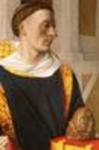
Estienne Chevalier, who came from Melun, was French Ambassador to England in 1445 and six years later became Treasurer to Charles VII of France. He presented the diptych of which this panel forms the left wing, to his native town; on this wing he had himself painted next to his patron saint, Stephen. The saint, wearing a deacon's robe, is holding a book, on which a jagged stone is lying, as a symbol of his martyrdom. The formal architecture in the background is in the Italian Renaissance style showing pilasters with colored inlaid marble panels between them. On the wall, receding in perspective, the name Estienne Chevalier is inscribed several times.
-
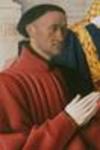
Etienne Chevalier with St. Stephen (right panel) Diptych de Moulin. Etienne Chavalier Presented by St. Stephen
Unknown
Estienne Chevalier, who came from Melun, was French Ambassador to England in 1445 and six years later became Treasurer to Charles VII of France. He presented the diptych of which this panel forms the left wing, to his native town; on this wing he had himself painted next to his patron saint, Stephen. The saint, wearing a deacon's robe, is holding a book, on which a jagged stone is lying, as a symbol of his martyrdom. The formal architecture in the background is in the Italian Renaissance style showing pilasters with colored inlaid marble panels between them. On the wall, receding in perspective, the name Estienne Chevalier is inscribed several times.
-
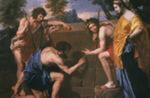
Et in Arcadia Ego
Unknown
Shepherds are seen before a tomb deciphering the inscription with an air of melancholy curiosity. The skull is no longer significant or is omitted. The words seem to imply an epitaph on the person, perhaps a shepherdess, who lies entombed: 'I too once lived in Arcady', an alteration to the meaning that somewhat stretches the grammar of the original Latin.In this version all sense of surprise has been removed, and instead, the shepherds are arranged in attitudes of contemplation round the tomb in the countryside. The artist has lost all interest in story-telling, and has concentrated on a totally static scene. No pleasure is taken in surface texture, and the whole is hard and cold, with the figures in statuesque poses.
-
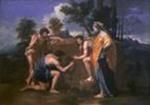
Et in Arcadia Ego
Unknown
'Et in Arcadia ego' is a phrase coined by Virgil and used in 17th century Italy expressing, in an elliptical way, the humanistic sentiment: Even in Arcadia I (i.e. Death) am to be found. That is to say, even the escapist, pastoral world of Arcady is no refuge from death. The words feature in paintings from that time inscribed on monumental stonework, especially a tomb, which stands in rural surroundings. The earliest representation of the theme by Guercino (Galleria Corsini, Rome) shows two shepherds coming unexpectedly upon a skull - the typical memento mori - that lies on a piece of fallen masonry bearing the words 'Et in Arcadia ego'.
-
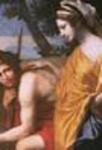
Et in Arcadia Ego (detail)
Unknown
In this version all sense of surprise has been removed, and instead, the shepherds are arranged in attitudes of contemplation round the tomb in the countryside. The artist has lost all interest in story-telling, and has concentrated on a totally static scene. No pleasure is taken in surface texture, and the whole is hard and cold, with the figures in statuesque poses.
-
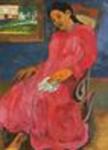
Faaturuma (detail) Melancholic
Unknown
Gauguin's title, Faaturuma, is inscribed on the frame of the unidentified landscape painting which hangs on the back wall of the room (surely one of the artist's own works). The Museum's picture evokes a mood of quiet detachment or melancholia and suggests something other than straightforward portraiture. The arabesque forms of the dress and rocking chair seem to accentuate the sitter's isolation, while the simple color scheme based on the primary colors of red, yellow and blue further contribute to the monumental character of the figure. The general composition seems to have been inspired by Corot's La Lettre (The Metropolitan Museum of Art, New York), a photograph of which is known to have been among Gauguin's possessions in Tahiti.
-
Faaturuma (detail) Melancholic
Unknown
Gauguin's title, Faaturuma, is inscribed on the frame of the unidentified landscape painting which hangs on the back wall of the room (surely one of the artist's own works). The Museum's picture evokes a mood of quiet detachment or melancholia and suggests something other than straightforward portraiture. The arabesque forms of the dress and rocking chair seem to accentuate the sitter's isolation, while the simple color scheme based on the primary colors of red, yellow and blue further contribute to the monumental character of the figure. The general composition seems to have been inspired by Corot's La Lettre (The Metropolitan Museum of Art, New York), a photograph of which is known to have been among Gauguin's possessions in Tahiti.
-
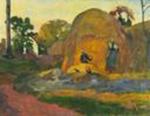
Fair Harvest
Unknown
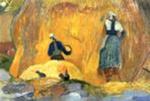
The haystacks were a subject commonly treated by the impressionist painters in this period when they started painting outdoors. Millet had shown the way, Van Gogh painted some around Arles in 1888 and Monet will paint a famous series in 1991. But it was in a farmyard that Gauguin would set-up his easel to paint two women doing imprecise tasks on an large rick of hay. He used the complete range of yellows to give a butter-like thickness to it. The bottom of the painting was worked more quickly and shows the parallel strokes that were one of Gauguin's trademarks.
-
Fair Harvest. (detail)
Unknown
The haystacks were a subject commonly treated by the impressionist painters in this period when they started painting outdoors. Millet had shown the way, Van Gogh painted some around Arles in 1888 and Monet will paint a famous series in 1991. But it was in a farmyard that Gauguin would set-up his easel to paint two women doing imprecise tasks on an large rick of hay. He used the complete range of yellows to give a butter-like thickness to it. The bottom of the painting was worked more quickly and shows the parallel strokes that were one of Gauguin's trademarks.
-
Fair Harvest. (detail) Yellow Hay Ricks
Unknown
The haystacks were a subject commonly treated by the impressionist painters in this period when they started painting outdoors. Millet had shown the way, Van Gogh painted some around Arles in 1888 and Monet will paint a famous series in 1991. But it was in a farmyard that Gauguin would set-up his easel to paint two women doing imprecise tasks on an large rick of hay. He used the complete range of yellows to give a butter-like thickness to it. The bottom of the painting was worked more quickly and shows the parallel strokes that were one of Gauguin's trademarks.
-
Female Nudes Bathing
Unknown
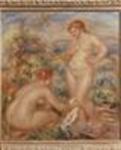
Southern France offered Renoir scenes bursting with color and sensuality. At the same time, the seemingly joyous spontaneity of nature gave him the desire to depart from his newfound adherence to the dictates of classicism. While in southern France, he recovered the instinctive freshness of his art; he painted women at their bath with the same healthful bloom he would give to bouquets of flowers.
-
Female Nudes Bathing (detail)
Unknown
Southern France offered Renoir scenes bursting with color and sensuality. At the same time, the seemingly joyous spontaneity of nature gave him the desire to depart from his newfound adherence to the dictates of classicism. While in southern France, he recovered the instinctive freshness of his art; he painted women at their bath with the same healthful bloom he would give to bouquets of flowers.
-
Flight into Egypt
Unknown
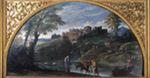
The picture belongs to a cycle of lunettes with landscapes and a religious theme. This cycle constitutes a milestone in the reconstruction of the painting of landscapes in seventeenth-century Rome. The teaching of Annibale was to remain an indispensable
-
Flight into Egypt (detail)
Unknown
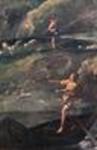
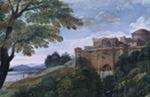
Every landscape element is classically balanced and perfectly integrated with the learned citing of ancient buildings, working together to create the so-called
-
Flight into Egypt (detail)
Unknown
Every landscape element is classically balanced and perfectly integrated with the learned citing of ancient buildings, working together to create the so-called
-
Flight into Egypt (detail)
Unknown
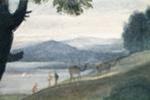
The "classical," composed, measured and ideal landscape of the Flight into Egypt, one of the works that set the ground rules for seventeenth-century painting. The restful setting, the gently undulating planes that extend to the distant horizon, and even the boat - a symbol of life - floating on a peaceful river in the foreground create a most unusual atmosphere, based on the effect of repetition. This motif of the "already seen" and known, a constant feature of Italian landscape painting,
-
Flight into Egypt (detail)
Unknown
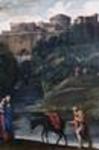
Every landscape element is classically balanced and perfectly integrated with the learned citing of ancient buildings, working together to create the so-called