-

Isotopic Study of the Waters from the Sulphur Springs Catchment, Tampa, Florida
Esra Zengin
A stable isotope study was carried out using precipitation, spring water, groundwater well sample, and a seawater sample during the wet season in the Sulphur Springs watershed in Tampa, Florida. Studies that track long term isotopic variation over wet seasons are limited in the region. To fill this knowledge gap, this study aims to quantify the contributions of precipitation and diffuse sources to discharge in Sulphur Springs. A three-component mixing model was applied using δ18O and δ2H values to determine different source water contributions to spring water discharge. The three-component mixing model calculations suggest spring water consists mainly of diffuse water sources, up to 76.98%. The spring water contains significant proportion of saltwater with the proportion of 21.6% while precipitation contributes 16.4% of the spring discharge for the whole study period. For this short four-month, which may not reflect the entire year’s physical situation, the mixing model results show that recharge input from a precipitation does not contribute significantly to the karstic spring discharge. The study’s results show that with the use of δ18O and δ2H, insights can be provided into the various short-term contributions of the various water sources to a karstic spring located in an urban area using δ18O and δ2H.
-
Article, Sulphur Springs’ Past Reminds Us that Sustainability and Justice are Deeply Entwined, November 23, 2021
Amanda Hagood
An article by Amanda Hagoodin Creative Loafing Tampa Bay about the Sulphur Springs neighborhood in Tampa, Florida.
-
The Ecology and Conservation of an Urban Karst Subterranean Estuary
Robert J. Scharping
Sulphur Springs is an artesian spring and part of the limestone karst topography of metropolitan Tampa, Florida, USA. Underlying this spring is an extensive cave system that hosts saltwater vents and conspicuous microbial biofilm communities. For decades, water from Sulphur Springs has been extracted and used to supplement public water supply and dry season flows in the Hillsborough River Estuary. This dissertation describes research conducted at Sulphur Springs to determine the impacts of urban land use on the underlying cave and downstream estuary ecosystems, and presents the use of this system as a model to fill certain ecological knowledge gaps. Techniques from a wide array of disciplines were used to address these questions, such as molecular biology, stable isotope geochemistry, hydrogeology, and multivariate statistics. The introduction provides a brief background about the major anthropogenic changes faced by groundwater-dependent ecosystems. The first chapter presents evidence for a conceptual model that explains how seawater intrusion accelerated by groundwater extraction has occurred at Sulphur Springs. The second chapter addresses knowledge gaps in the concepts behind the use of microbial indicators in groundwater, and applies the microbial indicator tool to inform management strategies at Sulphur Springs. The third chapter demonstrates how the use of extracted groundwater to supplement riverine discharge impacts carbon fluxes in estuaries, and how groundwater extraction from karst springs can change underlying cave ecosystems. The concluding remarks propose future directions for ecological research in karst subterranean estuaries and coastal landscapes. Overall, this dissertation demonstrates how anthropogenic activity can modify coastal groundwater and estuary ecosystems, and emphasizes how local management strategies are causing fundamental ecological change at Sulphur Springs.
-
An Ethnography of WaSH Infrastructures and Governance in Sulphur Springs, Florida
Mathews Jackon Wakhungu
This dissertation describes the forces that shape the perceptions and practices in Water, Sanitation, and Hygiene (WaSH) services in the community of Sulphur Springs, Tampa, Florida. It also explores how these forces, perceptions, and practices produce adverse experiences and inequalities in water, sewer, drainage, and laundry services. This ethnographic study combines participant observation, ethnographic interviewing, freelisting, oral history, and GIS to uncover the context, experiences, and perceptions about WaSH in Sulphur Springs. The study finds that the present conditions and perceptions about WaSH are embedded into the historical contexts—especially racial segregation, the construction of the interstate, and multiple economic downturns in the neighborhood. Collectively, these forces have influenced the demographic, socioeconomic, and infrastructural makeup of the community, but also shaped conversations about WaSH. These forces also intersect to create a climate of silence and a lack of collective voice, further complicating the WaSH situation for underserved and marginalized groups. The study reveals that the aging infrastructures mean WaSH amenities break down frequently, and that is made worse by hands-off governance styles by last-mile service providers. For water, the concerns are primarily about water quality, while solid waste problems and inadequate drainage infrastructures constitute drainage concerns. Unfortunately, residents with low-income and in rental housing units were the ones who bear the brunt of WaSH service insecurity in Sulphur Springs. This project gives an account of people's experiences but also seeks to contribute to ongoing efforts to confront the challenges that stand in the way of the residents' water, sanitation, and hygiene goals.
-
Desert in the Springs: Ethnography of a Food Desert
Margeaux Alana Chavez
"Food desert" commonly describes food insecure areas with few fresh food outlets. Though used in a number of sources, the definition of "food desert" remains largely undeveloped and research is often deficit oriented, failing to account for community assets that may exist within food deserts but are underutilized or under-supported. Using an assets-based, ethnographic approach, this study combines GIS and survey methodology with participant observation and qualitative interviews to assess the potential positive effect of urban agriculture on food accessibility in Sulphur Springs, a USDA identified urban food desert in Tampa, Florida.
Ethnographic data suggest that within this neighborhood, residents are largely dissatisfied with the quality of goods and services provided by local food retailers and, in response, seek alternatives to local retail food options. GIS and food store survey results from this study suggest that urban agriculture has the potential to increase fresh food accessibility and availability. Qualitative interview data suggest that the most appropriate way to improve food accessibility in this particular community is through Community Supported Agriculture that fosters social connections, while increasing access to healthful, quality foods, and circulating money within the community.
-
Assessment of “Community Stepping Stones,” a Community-Based Youth Art Education Program
Jennifer E. A. Pedraza
Community Stepping Stones is an art education program whose objective is to
“provide education, mentor children and adolescents, enhance the community
economics, and enrich the quality of life in the community” (Community Steppping
Stones [CSS], 2009a). Community art education programs, particularly for youth, have
become increasingly popular as a way to address and prevent delinquent behavior.
However, art education programs have proven challenging to evaluate and sustain.
The goal of my thesis was to explore how Community Stepping Stones
implemented and evaluated a community-based youth arts education program
compared to other, similar programs and how the organization could make the program
more effective and more sustainable long-term. As part of an internship with Community
Stepping Stones, I conducted participant observation, document review, and interviews
with individuals affiliated with Community Stepping Stones and other art education
programs in the community. Data was collected between February 2009 and September
2010.Community Stepping Stones has grown significantly during my involvement with
the organization, expanding funding, programming, and staff. Current efforts to reinforce
evaluation measures and secure additional funding sources will help make the program
more sustainable in the future. Additional efforts towards collaboration with other
community and government organizations, increased community involvement, and better
program organization will also be beneficial towards sustainability efforts.
At this time, published evaluations of community-based youth art education
programs and organizational impact on youth and community are limited. Although not a
comprehensive assessment, I hope my research can help bolster the literature in this
area.
-
Underground Florida: a fieldtrip guidebook of the west central Florida karst
Kali J. Pace-Graczyk, Aurel Perşoiu, and Jason Samuel Polk
Describes select karst formations in the central Florida region. Open Access World Karst Aquifer Map See Extended description for more information.
-
Proceedings of the 2003 National Cave and Karst Management Symposia National Cave & Karst Management Symposia NCKMS
Sandra Poucher, Michael Poucher, and G. Thomas Rea
16th National Cave and Karst Management Symposium Proceedings, October 13-17, 2003 Gainesville, Florida: Contents: The Florida Aquifer Vulnerability Assessment Model: A Tool For Aquifer Protection In Karst Setttings / Jonathan D. Arthur -- Investigation of Salinity Increases in Sulphur Spring, Tampa, Florida / K. Michael Garman, Sherry Garman, Jitka Hyniova, and Jakub Rehacek -- "Through the Roof" Monitoring Water Quality In Manatee Springs / Thomas H. Greenhalgh, III -- Results of Sampling for Selected Wastewater Constituents In Ground Water In the Silver Springs Basin, North Central Florida / G.G. Phelps -- Florida Spring Glossary and Classification System / Rick Copeland -- Management Controversies at Oregon Caves National Monument / William R. Halliday and Jay Swofford -- Proactive Cave Management on the Hoosier National Forest / Julian J. Lewis and Kelle Reynolds -- Using ESRI ArcPad to Inventory Cave Features / Jon Jasper -- A Comprehensive Cave Management Program at Carlsbad Caverns National Park / Dale L. Pate -- Gray Bat Trends in Missouri: Gated vs. Ungated Caves / William R. Elliott -- Quantitative Real-Time PCR Assays of Bacterial DNA in Sediments of the Flint-Mammoth Cave System with Evidence for Nitrospira Spp. At Sites Undergoing Limestone Dissolution and Karst Aquifer Evolution / Rick Fowler, Eli Roberson, and Shivendra Sahi -- Mercury and Methylmercury in the South Central Kentucky Karst: its Transportation, Accumulation, and Potential Effects on Vulnerable Biota / Kurt Lewis Helf, PhD -- Development of an Index of Biological Integrity for Endangered Species Monitoring in Southern Illinois / Julian J. Lewis and Salisa Taylor Rafail -- Mapping Presumptive Habitat for Subterranean Aquatic Species of Concern / Philip L. Moss and Thomas Aley -- The Foraging Range of a Central Texas Cave Cricket, Ceuthophilus secretus (Orthoptera: Rhaphidophoridae) / Steven J. Taylor, Jean K. Krejca, and Michael L. Denight -- Going for the Gold Award: Girl Scouts, Cavers, and Government Working Together for Cave and Karst Sourcewater Protection / Joseph H. (Joey) Fagan and Jessica E. Fagan -- National Cave and Karst Research Institute 2003: Working Through Partnerships Towards America's Future / Louise D. Hose and Penelope J. Boston -- Creative Partnerships for Water Quality in Karst Areas / Kriste Lindberg -- The Importance of Education in Karst Protection: the Virginia Experience / Carol Zokaites and Wil Orndorff -- Restoration, Not Just Conservation, of Bat Caves -- Need, Methods, and Case Study of a Myotis Sodalis Hibernaculum / Jim Kennedy -- Don't Mess With Mammoth Days in the Pike Spring Basin of Kentucky / Rick Olson -- Ecosystem Management and the Idea of Cave Wilderness In Protecting Karst Resources / Patricia E. Seiser, PhD -- Developing Conservation Sites for Virginia's Significant Caves / Wil Orndorff -- The Western Kentucky University Source Water Protection Program: Educating Water Resource Managers and the Public about the Vulnerability of Rural Karst Drinking Water Supplies / Chris Groves, Elizabeth Robb, John All, and Pat Kambesis -- A Systems Approach for the Understanding of Agricultural Contaminant Sources and Transport within a Karst Groundwater Drainage Basin / Patricia Kambesis -- Survey of Microbial Diversity within Wind Cave Using DNA Analysis, Wind Cave National Park, South Dakota / Rolland E. Moore. Open Access - Permission by Publisher Northup Database Collection See Extended description for more information.
-
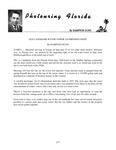
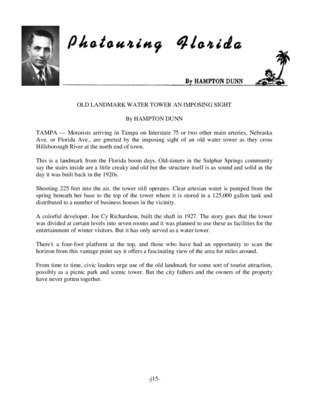
Old Landmark Water Tower an Imposing Sight, circa 1960s
Hampton Dunn
Photouring Florida column that describes the water tower at the north end of Tampa on the Hillsborough River.
-
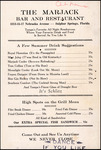
Specials Menu, Marjack Bar and Restaurant, Sulphur Springs, 1960
Marjack Bar and Restaurant
A specials menu for the Marjack Bar and Restaurant at 8213-15-17 Nebraska Avenue in Sulphur Springs, Florida.
-

Pamphlet, Sulphur Spring Hotel, circa 1935
Sulfur Springs Hotel (Tampa, Fla.)
Pamphlet advertising the Sulphur Springs Hotel and other activities in Sulphur Springs including swimming and golf and the Sulphur Springs Race Track for greyhound racing.