-
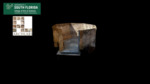
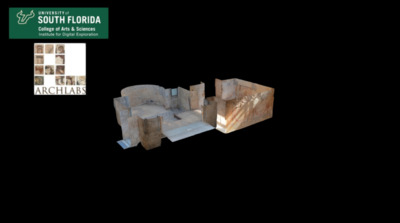
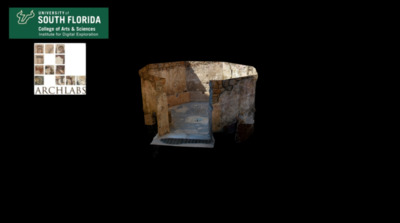
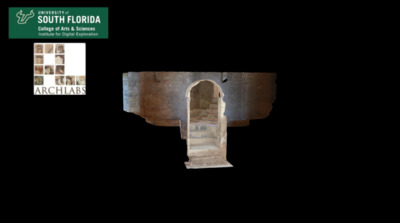
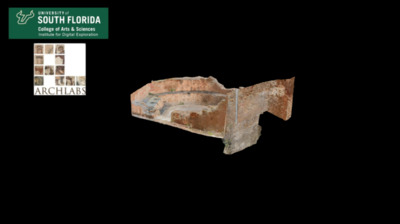
Polygonal Restroom (59)
USF Institute for Digital Exploration
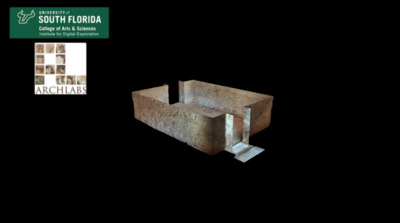
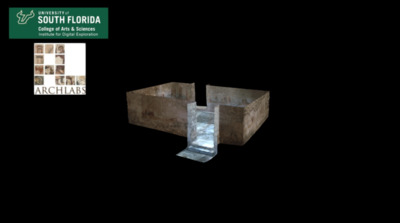
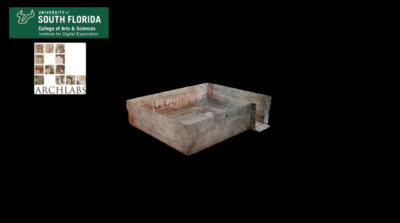
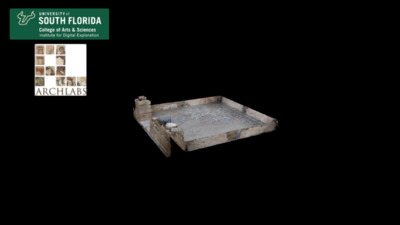
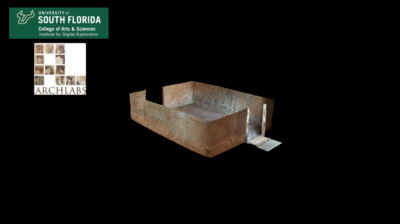
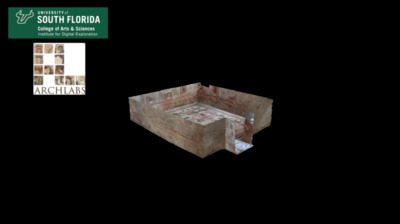
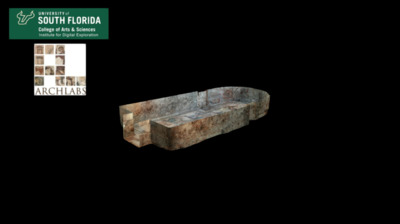
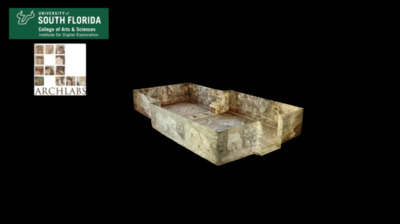
This octagon-shaped space is located between the walls of the eastern aqueduct and the east wall of the apsidal hall (41). Its proximity to the south main apartment and the triclinium (57) suggests that it was usually used by the dominus and his family, and by guests on special occasions such as banquets. A sewer, located just over a meter from the entrance, was used for the disposal of water. A well-kept water supply system also reached the basin placed at the foot of the wall located to the right of the door. It is decorated with bas-reliefs of acanthus leaves and inlays with a plant motif. The floor mosaic depicts a succession of white mosaic tiles outlines on a dark field. The shape of a large podded kantharos is en. The shoots open symmetrically across the floor’s surface.
-
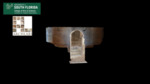
Private Entrance to the Baths (21)
USF Institute for Digital Exploration
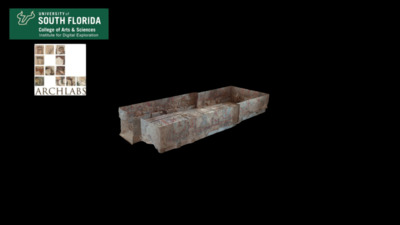
This room is accessed from the quadrangular peristyle (19d) through an opening to the south. The presence of masonry benches, which run along the walls, also explains its use as a vestibule-waiting room, or as an apodyterium. In the white field of the mosaic, framed by a simple black band, 5 figures are represented side by side: they are the Domina - the mistress of the house - her 2 children and 2 maids. The Domina wears a long dress and her hair is gathered in a helmet-like hairstyle. Next to her there are two young men with long hair wearing tunics. At the edges of the group are the two handmaids: one on the left, with a long dress with wide sleeves holding a box, and one on the right, wearing a yellow-golden tunic with red and black bands while carrying a red shoulder bag.
-
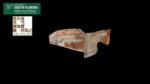
Private Latrine of the Peristyle (2)
USF Institute for Digital Exploration
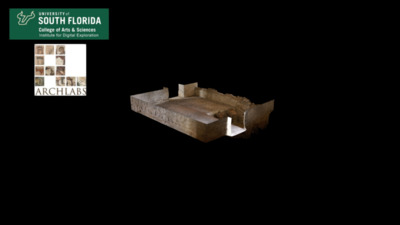
The floor of this private latrine is formed by rectangular or scaled polychrome mosaic tiles. In the center of the mosaic moving counterclockwise is imagery depicting a donkey, a hare, two birds, and a cat. The rendering of the profiles of animals and shadows, often drawn with a curved line, recurs in form and style in other mosaics in the rooms of the villa. The original walls are preserved up to 2.4 meters high. On the west wall there is a rectangular masonry basin covered with grey marble. These occupied the curved side of the space and that of the adjacent walls. The waste waters, to which were added those coming from the garden of the peristyle, flowed into the sewer beneath.
-

Quadrangular Peristyle (19a & 19d)
USF Institute for Digital Exploration
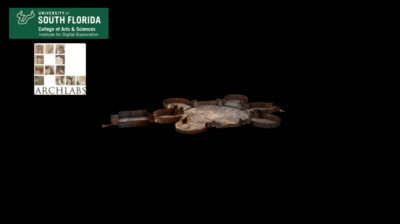
This space, accessed from the vestibule, connects all the rooms of the villa through a colonnaded peristyle overlooking an open-air center courtyard. The well-preserved mosaics have a polychrome geometric design, enclosed within a broken meander frame. The mosaic decoration of the floor runs along the entire room in a band of squares defined by a motif of intertwined ribbons with wild animals seen enclosed in wreaths of laurel leaves. The ends of the squares are decorated with birds and ivy. The direction of the protomes is not uniform along the wide corridor, indicating two paths.
-
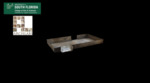
Second Service Room (23)
USF Institute for Digital Exploration
The use of this room as a second service room is confirmed by the execution of the geometric mosaic. The marginal flounce of the mosaic covering is profiled along the entire perimeter. The central part of the mosaic and a section of the east side are affected by gaps. The decoration appears almost uniformly in black and white, with hints of red or pink in some ornamental background elements. Surrounded by a large black band with six rows, located near the walls followed by a white band, the field is decorated with a pattern of adjacent hexagons with four-pointed black stars of different sizes. The four-pointed stars include a square inside, with a Solomon’s knot in the center. The lack of color and attention to detail in the making of this ornate mosaic make it an oddity compared to the others in the villa.
-
Semicircular Porch (40)
USF Institute for Digital Exploration
This well-preserved mosaic extends over the surface of the portico within an elaborate frame, consisting of a band in imitation of brecciated marble. The scene depicts a series of cherubic fishermen in pairs on six boats while two cupids are immersed in the water. Along the perimeter a horizon is outlined made up of a succession of villas with large rectilinear arcades, behind which a dense and diversified Mediterranean flora develops. The cherubs, represented naked or dressed in a short tunic, are all distinguished by the classic “V” or “U” sign on the forehead. The waters have numerous fish of different species such as groupers, squids, mullets, torpedoes, seahorses, lobsters, dolphins, eels, moray eels, and two wild ducks that swim in the center as a cherub tries to grab them.
-
South Master Apartment "Gym Room" (34 a1-a2)
USF Institute for Digital Exploration
This mosaic has been changed over time from a geometric style to a figurative style. This was likely due to water damage from pipes below the floor. Instead of repairing the original pattern, new designs were implemented. The geometric design is a perspective cubic frame around a pattern of eight-pointed stars containing a circular cord motif with floral designs. The figurative designs show female athletic figures (known as “the girls in bikinis”) arranged on two registers enclosed by a triangular frame. These women are depicted as competing in gymnastics events, and their “bikini” outfits were common suits for this. Events include a long jump, weight lifting, disc throwing, and the winner being given a victory palm and a crown of roses.
-
Tepidarium (6)
USF Institute for Digital Exploration
This room differs from other rooms due to the presence of the prefurni placed outside the apses and of the suspensurae (brick columns) aimed at keeping the floor suspended. These elements are part of the hypocaustum system used in the Roman baths to reheat the rooms by diffusing heat under the floors. The mosaic floor only has a few features. The northern section shows a lamphedromia, or “running with torches”. 2 images of athletes in motion are seen holding a round shield in their left hands and a lit torch in their right. The lower part of the mosaic shows the end of the race. To the right, 2 runners and a tubicen are seen. On the left, there are the joined legs of an athlete who has finished the race. In front of him is a character with a long tunic with rich ornamental motifs, perhaps the referee.
-
The Basilica (58 a-b)
USF Institute for Digital Exploration
The basilica is considered the most important place of public use, used for where the Dominus held his functions.
The rectangular hall (58a) is made up of partially preserved polychrome marble slabs spread over 7 bands with an east-west orientation. The marbles come from multiple Mediterranean regions. They contain squares and rectangles of different sizes. In the center of the room, a square, with concentric circles placed inside it, breaks the regularity of the pattern.
In the apse (58b) a larger square is visible with 4 circles placed in its corners. The rest of the mosaic has an irregular decorative motif, but in front of the throne there is a circular inlay. This is assumed to host a porphyry rota, but only parts of the concentric frames decorated with a wavy branch motif and lilies remain.
-
The "Little Hunt" Mosaic (30)
USF Institute for Digital Exploration
This stateroom of the villa displays a multi-register mosaic entitled “The Little Hunt”. The entire mosaic is enclosed by 3 intertwined ribbons flanked by 2 serrated frames on the exterior and 2 wavy white and blue ribbons. The 1st register depicts the departure for hunting and the pursuit of a fox. The 2nd shows the transport of a captured wild boar, and a scene of sacrifice and offering to Diana. The 3rd register depicts an open-air banquet under a large red tent and 2 hunters with falcons. The 4th register shows a breakfast scene flanked by depictions of a fox chased by the dog and the capture of a hare. The 5th register displays a deer hunt with nets. In the lower right corner there is the killing of a wild boar, and a wounded hunter on the ground.
-
Third Service Room (25)
USF Institute for Digital Exploration
This mosaic is partially intact, with large gaps that interrupt the design on the eastern side and in a central strip. It is a polychrome geometric design, with a frame made up from a series of recurring tuning forks. The marginal flounce is arranged with different measures to connect to the irregular walls. The complexity of the compositional scheme unfolds in a field with large eight-pointed stars, which create a series of rhombuses from which squares result. A 2-ply braid decorates these stars, and inside the octagons are bordered by a double thread and decorated with elements like a wavy ribbon crown and a flower or rose. The pattern with two secant squares, octagons and rhombuses can be seen in another room of the villa, the Chapel of the Lares (19a).
-

Triclinium Triabsidate (57 a-g)
USF Institute for Digital Exploration
This room is considered, after the basilica hall, the most regal and eloquent of the late antique residence due to the dynamism and sumptuousness of its architecture. The mosaic floor is divided into different scenes. In the central hall (57a) Hercules’ 12 labors are represented on different registers. In the northern apse (57c) Hercules is accompanied by Dionysus and is taken into Olympus by Zeus. In the north (57b) we see Daphne and Cyparissus transformed, respectively, into laurel and cypress. To the south (57e) the myth of Lycurgus is told as he tries to kill the nymph Ambrosia. She is saved by the intervention Maenads and Dionysus. Continuing east (57f), on the right is either Hesion or Andromeda with Endymion. In the apse facing the entrance (57g) are the Giants, pierced by the arrows of Hercules.
-
Vestibule (18 a-b)
USF Institute for Digital Exploration
This large rectangular hall’s mosaic decoration depicts both an official and a service function. The design of the central image is intact only in the northeastern part. It is defined by the patchy polychrome emblem of the central area, bordered by a black and a white band with a red profile inside. The scene represents people wearing plant crowns, ceremonial clothes, and hairstyles from the tetrarchic age. They are divided into groups and arranged in rows corresponding to different shades of color. The upper group depicts higher-ranking figures, the middle is the lampadarius (or ceremonial master), and the bottom is almost completely lost. All are slightly turned towards the right side of the scene, where it is assumed that the dominus was represented on horseback.
Printing is not supported at the primary Gallery Thumbnail page. Please first navigate to a specific Image before printing.