-
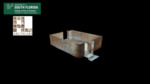
1st Room of the Private Apartment (26)
USF Institute for Digital Exploration
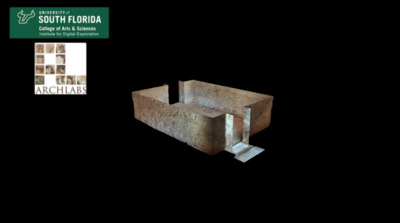
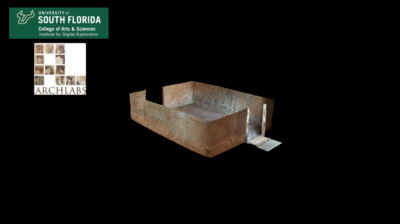
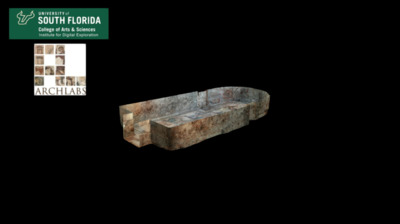
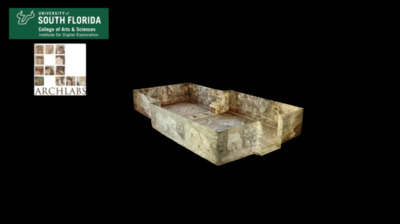
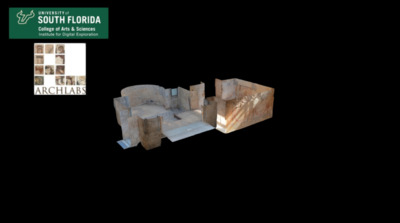
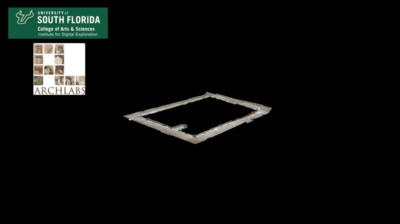
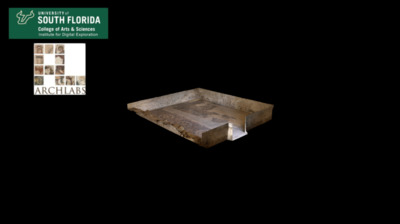
This rectangular room was a part of a private apartment that was used by the Dominus or by his guests. There are scarce traces of the original polychrome mosaic that more than likely represented a figurative theme instead of a geometric design. The marginal cliff, interrupted by a partition made in the Arab-Norman age, is made up of small pebbles and gray mortar and retains a small number of tesserae on the slope of the east wall.
-
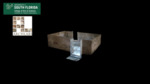
1st Service Room of South Master Apartment (33)
USF Institute for Digital Exploration
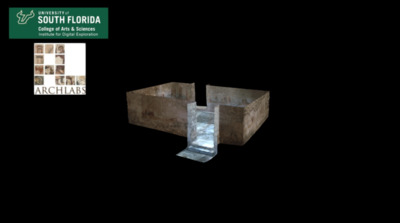
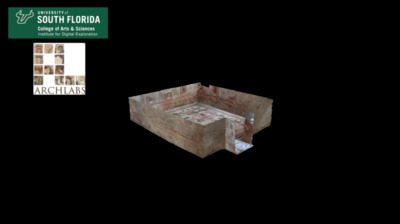
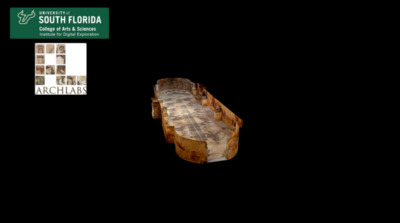
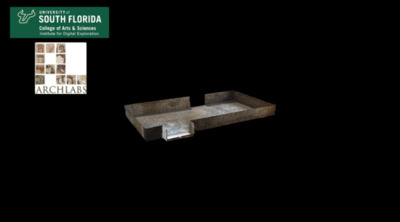
The geometric pattern of this mosaic is characterized by a checkerboard pattern, with squares divided by white bands that host hourglass motifs. These are interspersed with small flowers shown through two-tone rhombus shapes, a mill blade motif, and flowers with four almond-shaped petals. Sections are outlined by a spaced Greek frame with sloping colors, within which various geometric and floral motifs alternate. This type of mosaic design is very common in the Mediterranean area between the third and fourth centuries A.D.
A water pipe ran east to west below the floor, damaging the mosaic over time. This created a patchy band along the floor. After restoration work, the canalization can still be traced to the height of the manhole, which is still present in the floor today.
-
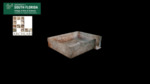
2nd Room of Private Apartment (27)
USF Institute for Digital Exploration
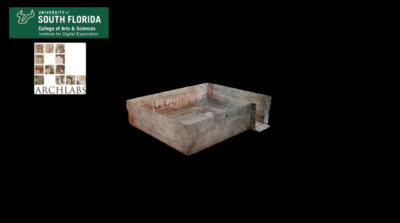
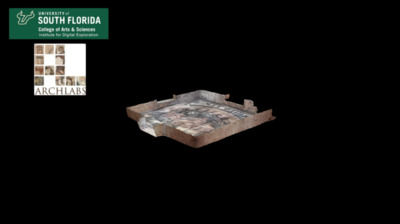
Surrounded by a double black border, this polychrome mosaic has numerous gaps unfolding irregularly across the floor. The scene depicted is almost theatrical, and takes place on two registers with 3 couples of dancers. In the upper band, the couple on the left depicts a female figure fleeing from a young man, who was in the large gap to her left. The central couple, is followed by a young man in the act of grabbing a girl by the waist. The last couple has a part of the head of the male figure and the joined legs of the young woman who is presumed to be dragged. The last iconography is incomplete forestry. This mosaic is believed to represent a dance enacting a kidnapping and perhaps, or the rape of the Sabine women, or a pyrrhic dance that evoked mythological subjects.
-
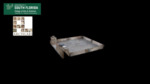
2nd Room on Northern Side of Ovoid Porch (49)
USF Institute for Digital Exploration
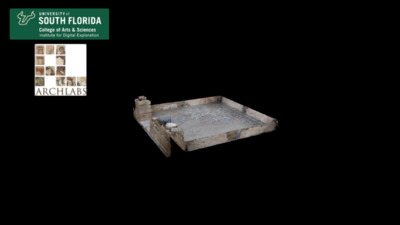
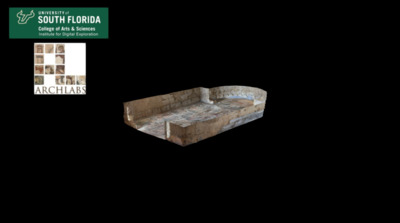
This rectangular room could have been frequented by guests or by the staff of the large estates who did not have access to the main rooms of the domus. It was used to lay down clothes before entering the triclinium, as a secondary refreshment place, or to sleep in. The mosaic depicts cupids cutting grapes in a field. They are surrounded by thick vegetation, and adorned with necklaces, bracelets, and armillas. They can be seen cutting the grapes with a billhook, or filling baskets full of berries. Their foreheads, marked by a “V” or a “U”, put them in relation with contemporary examples of the Tetrarchic period. The older figure within a wave frame has his head surrounded by a branch of vine leaves. On the still visible piece of mosaic, he wears a hazelnut-colored cloak and has a gnarled cane.
-

2 Service Rooms, North Master Apartment (31, 32)
USF Institute for Digital Exploration
These mosaics are almost intact, with only a few small gaps. The first mosaic is framed with arches on a dark background. It is a polychrome mosaic that is brightly decorated with geometric motifs. Ribbons formed by a 2-colored braid create a pattern of curvilinear octagons. Inside of the octagons is a jagged crown housing a floral motif. These octagons form rounds containing a broken Greek crown. The flow generates almond shapes arranged in crossed lines. The second mosaic is a geometric pattern that adapts to the structure of the walls. There is a crenellated dentello frame, with a triple thread outlining the perimeter based on a checkerboard pattern. Some squares are surrounded by a 2-ply braid, while their centers have another square with double black thread.
-
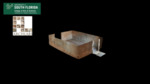
3rd Room of Private Apartment (28)
USF Institute for Digital Exploration
The mosaic in this room depicts the four seasons - Winter, Autumn, Summer, and Spring – in a series of medallions with figurative decorations inside. The geometric polychrome mosaic is framed by a series of perspective cubes with a pattern of secant hexagons and six-pointed stars. Some medallions also contain fish or birds. The comparison between the animal imagery and the seasonal designs could suggest that this room was utilized as a dining room, as well as the abundance of prosperity for the villa’s Dominus. The seasonal images and wealth of earthly goods could also suggest a theme of victory over time, and if combined with the imagery in the next room (29) also suggests a theme of the eternity of love.
-

4th Room of Private Apartment (29)
USF Institute for Digital Exploration
This polychrome mosaic is in good condition. It depicts an idyllic landscape of symmetrically arranged cupid fishermen. The foreground of the mosaic shows a marine view with thick underwater vegetation, and the background has a villa with a large portico. The realistic portrayal of the architecture follows the semicircular inlet of the rocky shore. The rest of the scene takes place at sea and is occupied by 4 boats, decorated with similar colors as the villa and adorned with different geometric motifs. Each boat has 3 cupid fishermen inside marked with a black “V” on the forehead – a distinctive sign of the tetrarchic era. The detail of the cupid fishermen being depicted without wings shows the tendency to humanize fantastical figures in these mosaics.
-
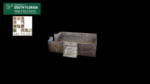
Antechamber of Apsidal Room S. Main Chamber (44)
USF Institute for Digital Exploration
The mosaic surface is well preserved and shows only slight gaps and a tear in the northeast corner. It depicts a race of floats pulled by birds and led by children richly dressed in the colors of their respective stables. The scene is bordered by a broken meander frame enclosed by two thick black bands. This mosaic is similar to that of the chariot race in the bi-apsidal hall (3), including the same colors for factions. There is also a central obelisk, seen from an angular perspective, and two metae, which close the ends around which the four small charioteers run, each for their own faction. The chariots are pulled by pairs of colored birds, and overall the scene has been interpreted as symbolic of the alternation of the seasons and the cyclicality of time.
-
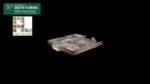
Antechamber of the North Master Apartment (37)
USF Institute for Digital Exploration
This room can be accessed from the ambulatory of the “Great Hunt” mosaic. It has a square plan with the function of anteroom and hallway for the other rooms of the apartment, and is hypothesized that it was intended solely for the Domina, or for the eldest son of the Dominus, or even used by the landlord as a private studio. The mosaic, bordered by a double braided frame enclosed by serrated bands, depicts Odysseus (Ulysses) in the cave of the cyclops Polyphemus. This section is narrated in Book IX of the Odyssey and represents the moment in which Odysseus, wearing the large red cloak and a short tunic, is offering a cup of his best wine to Polyphemus in order to get him drunk and later to blind the cyclops while sleeping.
-
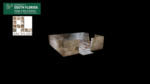
Antechamber of the South Master Apartment (42)
USF Institute for Digital Exploration
The surface on which the mosaic unfolds, almost entirely preserved, has an accentuated slope towards the east that has given rise to some gaps. The scene is bordered by a black frame and a geometric decorative band. This mosaic depicts the struggle between Eros, in the form of a child, and the savage Pan. The two contenders clash in the presence of Silenus. This scene is followed by two groups of figures, placed behind the two protagonists. Following Eros are two children wrapped in a soft himation and three women - possibly the Domina, a handmaiden, and a third woman. Pan is accompanied by mythical figures linked to the Dionysian circle, including 3 Maenads and a Satyr. The Satyr bears a pedum, and is pointing to the prizes available for the winner on the table in the center of the mosaic.
-
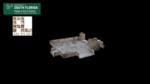
Antechamber on N. Side of Ovoid Portico (47)
USF Institute for Digital Exploration
It is assumed that this area could be frequented by guests or by the staff of the large estates who did not have access to the main rooms of the domus. The mosaic has large gaps in the middle and left side branching downwards, however the scene can still be seen. It depicts Dionysian themes similar to those in the Triclinium (57) and in the adjoining room (49). Within the mosaic, the process of transport and pressing grapes is seen. It begins with 2 wagons pulled by oxen, both overflowing with grapes. Cherubs can also be seen supporting objects related to the grape harvest. From there, the upper register depicts the pressing of the grapes by 3 putti that almost appear to be moving in a dance-like rhythm. On the sides, cherubs move towards the center carrying a basket and a seedling.
-
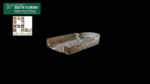
Apsidal Room, "Arione Room" (41)
USF Institute for Digital Exploration
This mosaic spans across the hallway and is almost entirely preserved. Bordered by a double plastic meander frame, a marine thiaus similar to that of the Frigidarium is seen. The marine procession depicts Ittiocentaurs, Tritons, Nereids, and a variety of aquatic and terrestrial animals. In the center of the mosaic, the figure of Arion stands out, playing a heptachord zither while riding a dolphin. Above him, 2 cherubs in flight take up the drapery of a nymph lying on the rocks listening to music. Other mythical beings can be seen in the waters of this large painting, depicted with waves marked by straight or zigzag lines. In the apse area, there is a monumental figure of Ocean, father of all waters, surrounded by a rich marine fauna.
-
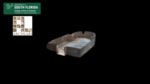
Apsidal Room, North Master Apartment (38a-c)
USF Institute for Digital Exploration
This private room contains a mosaic with seasonal fruits depicted. The mosaic’s geometric design consists of 9 large 12-pointed stars that create a series of rhombi with bands of alternating colors, and octagons decorated with shaded flowers. Representations of xenia are inscribed in laurel medallions containing various types of autumnal fruit, including yellow melons, a watermelon, cedars, a pomegranate branch, bunches of grapes, figs, chestnuts, apples, and pears. In the floor of the apse, within a frame of intertwined ribbons, a geometric motif of scales outlined in black on a white background develops, in each of which a stem with a bud, perhaps a rose, is inserted. There would have also been a figurative scene that has been almost entirely lost, with only parts of 2 cherubs remaining.
-
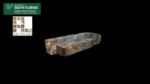
Apsidal Room of South Master Apartment (45a-b)
USF Institute for Digital Exploration
This room is considered the most important room inside the manor apartments. In it, 5 scenic representations are depicted with different themes. In the first section (45a), the upper register shows the final moment of a performance by musicians. The second register depicts 2 girls, with many sections lost. The last register reveals the lower part of a pair of tragedy characters. The first, a female figure, holds a mallet for the tympanum placed on a double step base. The second is a young poet reciting verses to a girl. The apse of the room shows a still legible mosaic set against a background with cut shoots full of roses (45b). At the center of the scene is a lady and a girl, sitting on overturned baskets and making garlands with rosebuds.
-
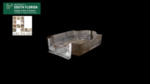
Apsidal Room, "The Dieta of Orpheus" (35)
USF Institute for Digital Exploration
The mosaic is disfigured by large gaps, but the scene can still be recognized. This mosaic is enclosed by a laurel-leaf frame running along the entire perimeter of the room. It depicts Orpheus, a mythical singer and poet, dressed in a large drapery. He turns his gaze to the distance, as if to seek poetic inspiration. Thanks to the sweet sound that his zither spreads, of which only a small tract remains, animals of all kinds gather around him. It appears to depict a section from Ovid’s Metamorphosis 142-143: “Such was the wood attracted by the poet, who sat in the maze of a flock of beasts and birds”. This mosaic puts the diaeta of Orpheus in dialogue with the room of Arione (41) by following the same apsidal structure. In both rooms, the triumph of virtue and reason over animal violence is recognized.
-
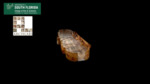
Bi-apsidal Hall (3)
USF Institute for Digital Exploration
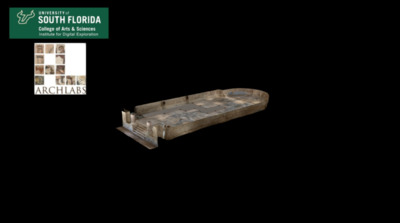
This large room is about 22 meters long and 6 meters wide. The grandeur of the space suggests a public destination. The hall was accessed by two entrances. The southern entrance was for visitors. The eastern entrance was for the Dominus and his family. The floor mosaic is a representation of a chariot race that takes place in the Circus Maximus in Rome. The four factions shown are the factio prasina (green), the russata (red), the albata (white) and the veneta (blue). The story of the race starts in the northern section of the mosaic and moves counterclockwise, including a crash between the green and red chariots and ending with the factio prasina’s win. In addition to the mosaic, this room is the only one to preserve frescoed walls up to almost 3 meters high.
-
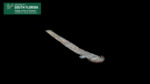
Corridor of "The Great Hunt" (36 a-c)
USF Institute for Digital Exploration
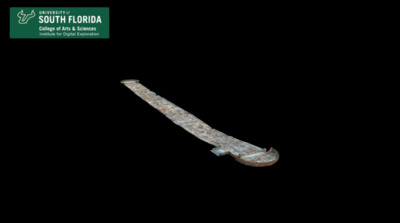
This long hallway mosaic depicts a scene known as the “Great Hunt”. It celebrates the apotheosis of imperial power through the capture and transport of exotic animals for games in the Roman amphitheater. This is represented across 7 scenes: they are divided into three registers: the upper band with a wild or urbanized landscape background, the central band by genre scenes with chases between animals, and the lowest band depicting the capture and transport of animals. The protagonists of the registers are three types of characters: military hunters, servants and transport workers, and officials. Other details include the personification of Mauretania, depictions of Italy as “the land between two seas”, and other regions of the globe like North Africa, Ethiopia, Carthage, Rome, and Egypt.
-
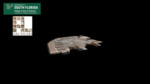
Courtyard with Portico Entrance (11 a - d)
USF Institute for Digital Exploration
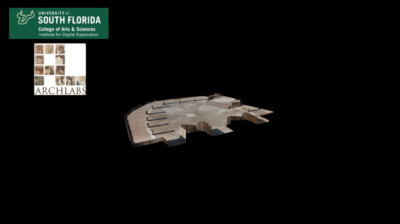
This space’s shape is reminiscent of a large pentagon with an irregular perimeter. It has a roofless courtyard in the central part and is covered with white limestone slabs that are square or rectangular in shape. Only a few traces remain of the pavement on the south and east sides, but the semicircular fountains to the north and the square fountain in the center remain. The center fountain is lined in white marble, with part of the foundational cocciopesto preserved. Its drainage waters had to flow into the drain placed on its southern side. The surviving mosaic floor of the portico shows a motif of two-colored scales.
-

Cubicle with Alcove (39a-c)
USF Institute for Digital Exploration
This room was more than likely a bedroom. Its mosaic is almost completely intact. In the main compartment within a frame known as a “wolf’s mouth”, is an elaborate geometric motif defined by a pattern of dodecagons, hexagons, and stars. The four seasons are portrayed around the dodecagon. Female theatrical masks also surround the dodecagon above laurel wreaths. In the center of these designs, inside a green laurel wreath, is one of the most famous scenes in the villa: two young people exchanging a kiss in a loving embrace. In this mosaic the seasons and masks are juxtaposed with the young couple symbolizing the eternity of love. The two lovers were also interpreted as the mythological figures of Eros and Psyche, and their mythical marriage symbolizes immortality.
-
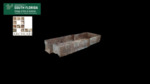
Cubicle with Alcove (43a-b)
USF Institute for Digital Exploration
This lively mosaic is divided into 3 registers, and is bordered by a crenellated dentello motif with florons. In the upper register, a boy strikes a hare with a venabulum. A second child stretches a hand forward. In the middle register, the children appear to be attacked by a rat and a rooster and are seeking help. In the lower register the hunting theme is resumed with a child hunting a peacock. The alcove mosaic is also in 3 registers. The first register shows 2 girls, possibly coronariae, picking flowers to place in wicker baskets. The second register shows a noble woman holding the ribbon of a woven wreath in her left hand while she picks up a flower from a basket. A young girl also holds up a basket of flowers. The last register shows a boy carrying 2 baskets of roses on his shoulders.
-
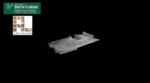
Entrance from the Square Peristyle (53)
USF Institute for Digital Exploration
The room was considered an official passage area for guests. In it, the mosaic depicts a kantharos on a white background with a black double-threaded frame. From the large truncated cone shaped container, two acanthus spirals with a heart-shaped apex emerge symmetrically. The small mosaic fragment preserved to the west contains four forepart of animals. The volutes, embellished with a vermilion ribbon, originate from large bi-colored pelt-shaped tufts and host, in the resulting lozenge-shaped areas, flowers and birds. This decorative acanthus head pattern covers the rest of the mosaic ornament and echoes, by contiguity, the same subject represented along the arms of the elliptical courtyard above.
-
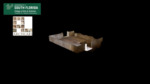
First Service Room (22)
USF Institute for Digital Exploration
Located on the western side of the quadrangular peristyle (19d), this room has a rectangular plan with a stone threshold entrance. The floor layer, dating back to the construction phase of the villa, highlights its service function through its geometric mosaic. The introduction of the medieval system interrupts the uniformity of the floor. The mosaic is bordered by a marginal flounce and develops a broken Greek frame. The field contains an octagon pattern adjacent to crosses, on the sides with full thread, and an elongated hexagon pattern, on the sides with serrated thread. The geometric decorations are made with different dimensions. The frames of the crosses containing braids, on the north side, are incomplete. The attention to the design of the mosaics confirms the destination as a service environment.
-

Frigidarium & Massage Rooms (5; 4a-i)
USF Institute for Digital Exploration
The Frigidarium is a large octagonal room with 2 swimming pools and 4 changing rooms. Its mosaic has both mythological and realistic imagery. Framed by faux polychrome marbles, a large maritime scene is arranged in a circular fashion. A marine thiaso is in the outer band, and fishermen of Eros are in the inner band. A procession of Nereids and Tritons is around them. Fish are between the linear and zigzagging waves. The theme of mutatio vestis, or “change of dress”, is also seen in the changing rooms.
The Massage Room depicts 5 people arranged within a corded frame. An athletic man can be seen in the center, flanked by 2 attendants. One is preparing to massage the gentleman, while the other has a vial of ointment. The last 2 servants have fabric bands with their names on them.
-
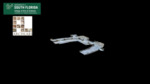
Ovoid Peristyle and Adjoining Rooms (46, 47, 49)
USF Institute for Digital Exploration
This large portico with its two adjoining rooms was meant to welcome visitors. The mosaic is minimally preserved on the northeastern side, but what can be seen shows a polychrome design in a herringbone pattern that could have been implemented to evoke the movement of water. The rest of the mosaic is delimited by a triple thread and depicts acanthus shoots developing from red and pink peltas that enclose different sizes of wild animals or birds in a spiral pattern. Rooms 47 and 49 have mosaics depicting the production of wine and fishing. The triclinium-peristyle-nymphaeum sequence represents the most original and functional design of the late antique residence, providing a large space for banquets, for strolling, and for leisure.
-
Passage Room (15 a-b; 1)
USF Institute for Digital Exploration
These rooms were used as passage rooms to connect the entrance courtyard and spa rooms. The geometric floor mosaic is has a decorated broken meander frame. Its made from a pattern of ellipses arranged diagonally that alternately create squares and octagons with curvilinear sides. Inside the ovals, with a braid pattern acting as a boundary, there is a red wave pattern framing a floral motif. In the squares there are four colored bands with segmented profiles. In the octagons there are ornamental flowers.
Traces of a fresco painting on the southern and eastern walls can be seen. They are organized in a series of square and rectangular panels there is a rod along which a wavy ribbon appears. In each of the ovals there are isolated figures seen.
Printing is not supported at the primary Gallery Thumbnail page. Please first navigate to a specific Image before printing.