Bronze Figure of Hercle in Lion Scalp & Skin
Files
Publication Date
11-12-2025
Time Period
3rd century BCE
Abstract
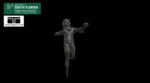
Hercle, Defender God: While the name derives from the Greek Heracles (Roman Hercules), the Etruscan Hercle was the son of the chief gods Tin and Uni (like Zeus and Hera or Jupiter and Juno). In the Archaic period, his appearance was influenced by the Cypro-Phoenician god Melqart. In later Etruscan depictions, as here, he can be recognized by the lion skin tied around his neck – an attribute of Greco-Roman art. Hercle was popular throughout Etruria and Latium, worshipped as an oracular god, the master of animals, and a defender against monsters.
Model Creation Date
03/27/2025
Sponsor/Stakeholder
Tampa Museum of Art
Keywords
Etruscans, Archaeology, Etruscan bronze figurines, Etruscan bronze sculpture, Etruscan art, Etruscan art objects
Alt Text
A three-dimensional model of a bronze sculpture of a nude, male figure with arms outstretched and one leg raised as if mid-run. There is partial damage to one of his arms and both of his legs. The model can be rotated, moved, and zoomed in and out to allow for viewing of additional details at multiple angles.
Extent
1 3D Model
Geographic Location
Italy; Hillsborough County (Fla.); Tampa (Fla.)
Media Type
Models (Representations); Renderings (Drawings)
Digitization Specifications
Method: Artec Studio 18 Professional Equipment: Artec Space Spider
Device Name
Artec Space Spider
Processing Software
Artec Studio 18 Professional
Download Size
71MB
Geometry
1M Triangles
Format
Digital Only
Materials
1
Rigged Geometries
No
Scale Transformations
No
Textures
1
UV Layers
Yes
Vertex Colors
No
Vertices
500k
Recommended Citation
USF Institute for Digital Exploration, "Bronze Figure of Hercle in Lion Scalp & Skin" (2025). Tampa Museum of Art Etruscan Collection. 2.
https://digitalcommons.usf.edu/etruscan/2
Book Location
Latitude
27.9495219
Longitude
-82.46266729999999
Rights Statement