-
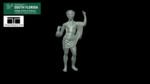
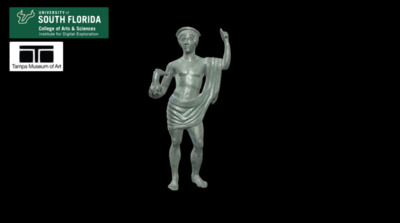
Bronze Figure of Aplu Holding Fawn
USF Institute for Digital Exploration
Aplu, God of Delphi: Adopted from Greece via Latium together with his twin sister Artumes (Artemis), Aplu (Apollo) retained his foreign character, especially as patron of the international oracular sanctuary at Delphi. Here he is portrayed with a short mantle draped over his left arm and waist, but otherwise nude, and crowned with a garland of laurel branches. His raised left hand would have held an attribute such as a lightning bolt. His outstretched right hand carries a small deer.
-
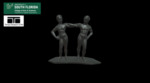
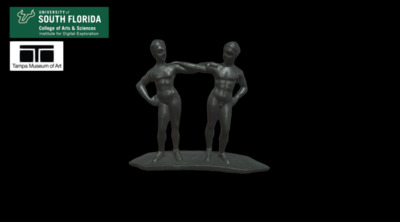
Bronze Figure of Embracing Man and Woman
USF Institute for Digital Exploration
This embracing couple – a man and woman, both nude – originally formed the handle of the lid of a bronze cista, a cylindrical cosmetic box. The couple’s loving embrace embodies a happy marriage and may indicate that the box was presented as a wedding gift. Cistae were the local product of Praeneste (present-day Palestrina), an Etruscan outpost southeast of Rome in Latium. Over 100 complete specimens are known to have survived. They were mostly recovered in illicit excavations during the 19th century from the tombs of the necropolis at Praeneste. While they served a funerary purpose to accompany the deceased in the afterlife, they have also functioned as toiletry boxes in daily life. Larger examples may have been used in ritual contexts.
-
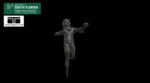
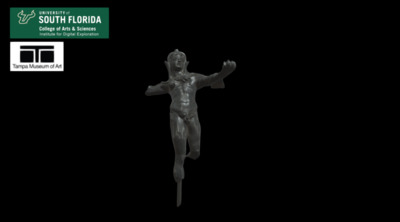
Bronze Figure of Hercle in Lion Scalp & Skin
USF Institute for Digital Exploration
Hercle, Defender God: While the name derives from the Greek Heracles (Roman Hercules), the Etruscan Hercle was the son of the chief gods Tin and Uni (like Zeus and Hera or Jupiter and Juno). In the Archaic period, his appearance was influenced by the Cypro-Phoenician god Melqart. In later Etruscan depictions, as here, he can be recognized by the lion skin tied around his neck – an attribute of Greco-Roman art. Hercle was popular throughout Etruria and Latium, worshipped as an oracular god, the master of animals, and a defender against monsters.
-
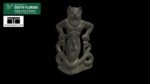
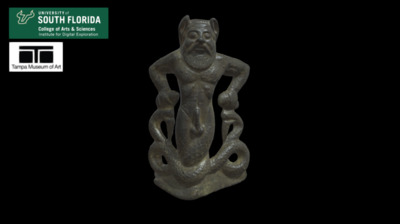
Bronze Figure of Typhon with Viper Coils
USF Institute for Digital Exploration
Typhon was the monstrous demon of chaos for Greek myth. Here his naked upper body has the form of bearded satyr with wild eyes, snub nose, and equine ears; his scaly legs morph into two coiling, bearded serpents. The figurine was originally attached to an incense burner (thymiaterium).
-
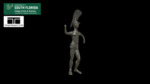
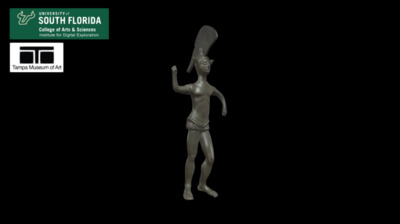
Bronze Figure of Umbrian Warrior
USF Institute for Digital Exploration
Umbrian Warrior: This bronze statuette depicts a warrior standing proudly with his right arm raised – originally holding a spear – and his left arm slightly lowered – originally carrying his shield. He wears a tall crested and winged helmet, breast plate and short kilt. The figurine probably portrays a soldier. Its elongated form reflects Umbrian traditions, rather than Etruscan. The Umbrians were an Italian people linguistically related to Latin and Oscan, inhabiting the Apennine mountains to the east of Etruria – and the chief enemies of their western neighbors.
-
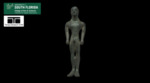
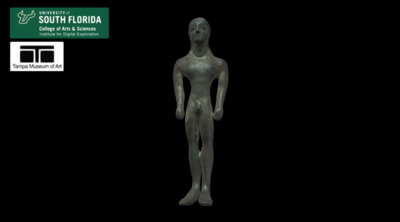
Bronze Figure of Young Man
USF Institute for Digital Exploration
With his broad shoulders and narrow waist, as well as his neat hairstyle (short in the front, long in the back), this bronze figurine illustrates the influence of Greek sculptural art in Etruria. In Archaic Greece, the kouros (“youth”) reflected the ideal male beauty – nude, noble and athletic. Greek kouros-type sculpture, with its stiff pose – arms along the body, straight legs and left foot stepping slightly forward – was itself inspired by Egyptian artistic tradition. This charming bronze statuette is therefore an example of the interconnectedness of the ancient world.
-
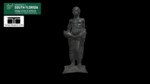
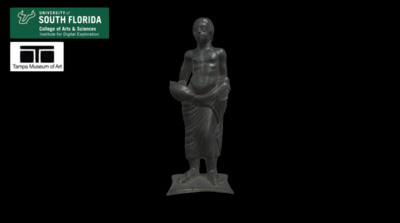
Bronze Figure of Young Man Holding Dish
USF Institute for Digital Exploration
Young Man Offering Figure of a young man standing bare-chested with a mantle draped around his waist and lower left arm. He is bringing a libation of olive oil or wine from the bowl in his right hand.
-
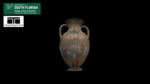
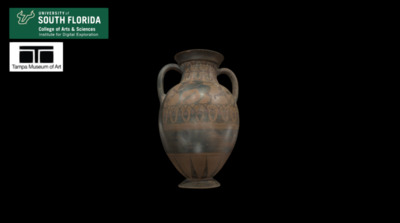
Ceramic Amphora with Sphinxes and Lotus Flowers
USF Institute for Digital Exploration
Two black-figure sphinxes, striding to the left, are featured on either side of this two-handled storage vessel (called a Pontic-style neck amphora). Decorated with added red and white, one forepaw raised, their feathered wings curving upwards and their tails coiling in spirals, three of the sphinxes have white painted heads, the fourth head is black. The amphora is further enlivened with lotus flowers and buds, palmettes and other floral designs.
-
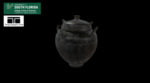
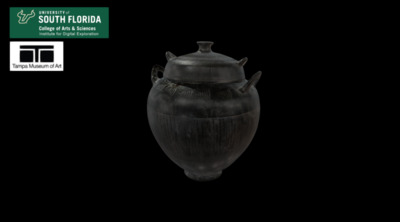
Ceramic Blackware Stamnos with Lid
USF Institute for Digital Exploration
Lidded Urn: Ovoid bucchero sottile storage vessel with upturned handles, standing on a low foot. The shoulder is decorated with an intricate incised pattern of alternating full and half-open fans. The body has vertical flutes and rays above the foot. The lid has a central knob handle and two upturned perforated lug handles, with sets of incised concentric rings, the sides with rotating half-open fans. The vessel’s shape is reminiscent of the Greek stamnos, first produced in Laconia and Cyprus in the Archaic period, before being adopted in Attica, ca. 530-525 BCE. The container could store liquids, like an amphora, or mixing wine with water, like a krater. This lidded example may have been used as an urn to contain the cremated ashes of the deceased.
-
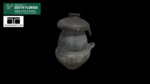
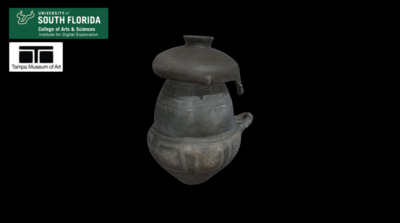
Ceramic Blackware Urn with Lid
USF Institute for Digital Exploration
Burnished black-slip impasto ware urn with single round handle decorated with incised geometric designs. The irregular, hand-made two-tiered shape resembles two cones, one placed on top of the other. The lid, shaped like a bowl with its own round handle, has a different type of design – and may not have belonged to the urn. Characteristic of the Villanovan period, such vessels contained the cremated remains of the deceased.
-
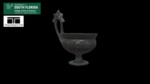
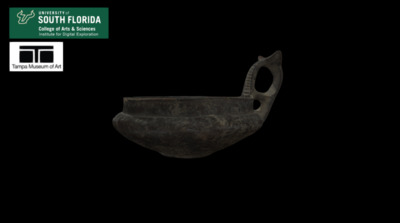
Ceramic Etruscan Kyathos
USF Institute for Digital Exploration
A bucchero sottile drinking cup on a high stem with flaring foot. The body is ornamented with alternating buds and petals. The exterior of the lip is incised with a zigzag band between parallel horizontal lines, the interior with two horizontal lines. The strap handle extends prominently above the rim. The top is decorated with a stylized, double-sided head of Potnia Theron (“Mistress of Animals”). An additional bar joins the handle to the rim. An applique male head marks the join of the handle with the rim of the cup. Known as kyathos, this class of cups was an originally Etruscan shape. This particular type was popular at Vulci in the Archaic period. The term kyathos, however, is derived from the Classical Greek word for a ladle to draw wine from a mixing vessel.
-
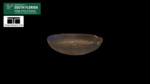
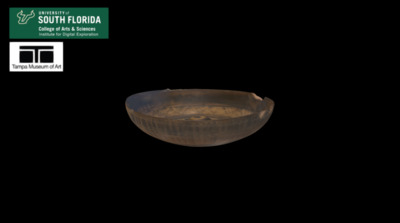
Ceramic Libation Bowl with Raised Boss
USF Institute for Digital Exploration
Bowl with raised boss (phialē mesomphalos) decorated with wave and trellis patterns. Such bowls could be used for pouring libations of wine or olive oil at a house shrine, in a sanctuary, or at the funeral.
-
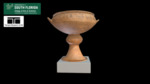
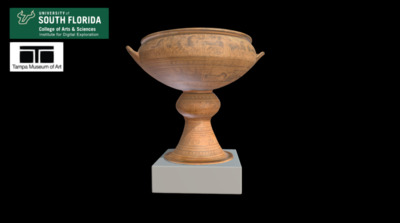
Ceramic Mixing Vessel on Stand
USF Institute for Digital Exploration
The impressive bowl with round handles on a high foot is decorated in red-brown on a buff ground with figurative and geometric patterns. The upper panel shows riders on horseback with birds above or below. Other panels show kneeling horses and birds. The noteworthy shape of this bowl, thrown in one piece on the potter’s wheel, is called “standed dinos,” once lidded (now missing) and used as an ash urn. The shape is inspired by metal vessels from the Eastern Mediterranean, the design by Greek Geometric examples. Adapted from local southern Etruscan tastes, this vessel demonstrates the broadening of the Etruscan horizon beyond central Italy in the late 8th century BCE.
-
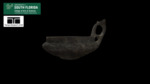
Ceramic Villanovan Kyathos
USF Institute for Digital Exploration
Cup with Ring Handle: Dark-brown impasto drinking cup (kyathos) with a single, horned handle, attached to the rim and looping in a ring to the shoulder. The shape, dating to the Villanovan period, was an Etruscan creation; the word kyathos, however, is Greek, and refers to a wine ladle inspired by the Etruscan cup.
-
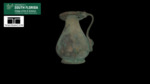
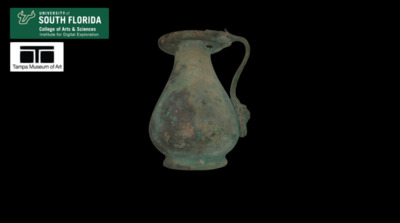
Olpe with Maenad's Bust
USF Institute for Digital Exploration
Large pear-shaped pitcher with a single handle that has a finial applique at the base in the form of a bust of a female follower of Dionysus (maenad).
-
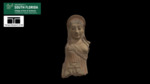
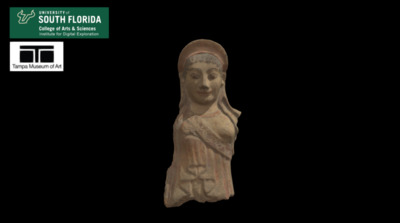
Terracotta Figure of Young Woman
USF Institute for Digital Exploration
A painted, mold-made terracotta statuette in the shape of a young woman, likely serving as an architectural decoration of a temple pediment. In style derived from the Archaic Greek korē (“girl”), she wears a crown (stephanē) in her curly hair, as well as a veil falling over her shoulders, an embroidered and hemmed tunic (chitōn) and a stylized pleated overgarment (himation) with an embroidered band across her chest. Her lovely face is characterized by the archaic smile as well as thin arching brows over her large almond-shaped eyes.
-
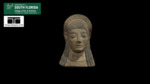
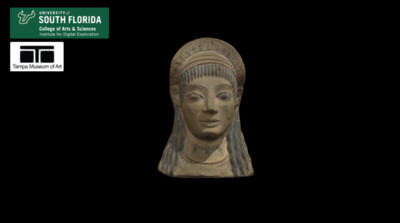
Terracotta Head of Young Woman
USF Institute for Digital Exploration
A painted, mold-made terracotta roof fixture (antefix) in the shape of a woman’s bust. Her oval face is brightened by the archaic smile, the slight upward curve of the mouth. She wears a head cloth under a decorated conical hat (tutulus) and a necklace with acorn-shaped pendants (bullae). The raised hem of her tunic (palla) is marked in molded relief. Adopted from Greco-Roman architecture, variously shaped antefixes were used on Etruscan temples to conceal the joints of the roof tiles at the eaves. Like the korē-figure, the identity of this head remains unclear, but may portray a maenad, a follower of the wine god Fufluns-Pacha (Dionysus or Bacchus).
The Tampa Museum of Art Etruscan Collection digitized by USF's Institute for Digital Exploration.
Printing is not supported at the primary Gallery Thumbnail page. Please first navigate to a specific Image before printing.