Art and Art History Collection (Saskia)
Files
Download image (4.0 MB)
Publisher
Saskia, Ltd., Cultural Documentation
Publication Date
January 1966
Time Period
18th Dynasty & 7th century CE conversion
Abstract
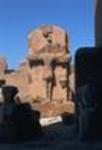
1 of 3 statues originally erected by Thutmose III, converted by early Christians to a crucifix
Keywords
New Kingdom, 18th Dynasty, Ancient architecture, Temple complexes, Statues, Sculpture (visual works), Coptic (Orthodox Christianity), Stelae
Alt Text
A large stone statue of a figure standing within a niche, surrounded by ancient ruins under a clear blue sky. Smaller stone figures and architectural elements are visible in the foreground.
Extent
1 color photograph
Geographic Location
Egypt; Luxor (Egypt); Karnak Temple Complex (Luxor, Egypt)
Rights
This material is licensed by USF Libraries for the research and teaching needs of USF students, staff, and faculty only. See: https://lib.usf.edu/collections-and-discovery/collection-management/user-terms/
Access Restrictions
Only thumbnail images and descriptive information are available to non-USF users. Full access to this collection is available only to authorized users on the USF network on campus or via VPN.
Media Type
Color photographs
Format
Digital Only
Note
This is a heavily damaged sandstone triad statue of Pharaoh Thutmose III flanked by two deities. It is located within the Akh-menu, or Festival Hall of Thutmose III at the Karnak Temple Complex in Luxor, Egypt. The red sandstone stele originally depicted 18th Dynasty Pharaoh Thutmose III, who would have been wearing traditional attire and headdresses. Around the 4th-7th centuries CE, early Copic Christian communities settled in the abandoned temples of Luxor. They converted parts of the central figure's horizontal shoulder line to make him resemble a Christian cross or crucifix.
Identifier
A01-JEA0158
Recommended Citation
Unknown, "Karnak Temple Complex, Statue of King Thutmose III at the Akh-menu" (1966). Art and Art History Collection (Saskia). 79.
https://digitalcommons.usf.edu/saskia/79