Art and Art History Collection (Saskia)
Alternative Title
Medinet Habu
Files
Download image (4.1 MB)
Publisher
Saskia, Ltd., Cultural Documentation
Publication Date
January 1966
Time Period
circa 1184-1153 BCE
Abstract
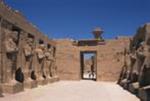
Open courtyard of Temple of Ramsses III, Osiride pillars of Ramsses III line the walls
Keywords
New Kingdom, 20th Dynasty, Ancient architecture, Temple complexes, Osiride pillars, Statues, Sculpture (visual works), Hieroglyphics, Pylons (gateway)
Alt Text
Ancient stone structure with large statues lining a pathway leading to a central doorway under a clear blue sky. The statues are positioned symmetrically on both sides of the path.
Extent
1 color photograph
Geographic Location
Egypt; Luxor (Egypt); Karnak Temple Complex (Luxor, Egypt)
Rights
This material is licensed by USF Libraries for the research and teaching needs of USF students, staff, and faculty only. See: https://lib.usf.edu/collections-and-discovery/collection-management/user-terms/
Access Restrictions
Only thumbnail images and descriptive information are available to non-USF users. Full access to this collection is available only to authorized users on the USF network on campus or via VPN.
Media Type
Color photographs
Format
Digital Only
Note
This is the first courtyard of the temple, with Osiride statues of the king flanking the walls. The ones on the west wear the red crown of the Upper Egypt, with the ones on the east wearing the white crown of Lower Egypt. These Upper Egyptian figures on the west hold the hek scepter in the left hand, with the nekhakha scepter in their right. These statues show Ramsses in his jubilee vestments, an uncommon surviving example of the pharaoh's traditional long beard. The open court was part of the temple’s processional route, likely used for ceremonial processions, religious festivals, and the display of royal statuary. Its openness allowed light and air, contrasting with the enclosed hypostyle hall beyond. The placement of the statues here emphasized Ramesses III’s divine authority and the pharaoh’s role in the temple’s religious life. The courtyard lies between the temple's Second Pylon (south) and the hypostyle hall. The Kiosk of Taharqa can be seen in the background.
Identifier
A01-JEA0157
Recommended Citation
Unknown, "Karnak Temple Complex, Open Courtyard of the Temple of Ramesses III" (1966). Art and Art History Collection (Saskia). 78.
https://digitalcommons.usf.edu/saskia/78