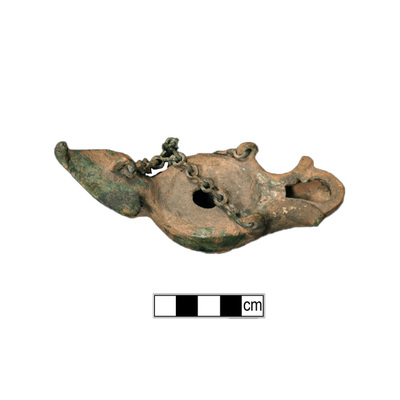
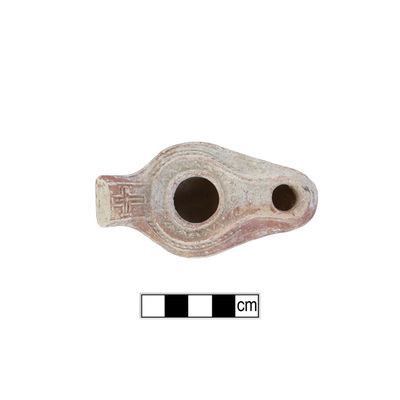
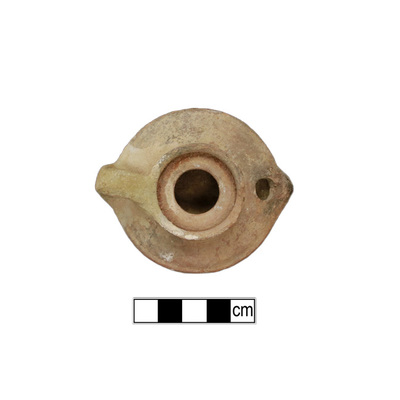
The Farid Karam Antiquities Collection at USF by Institute for Digital Exploration (USF IDEx) on Sketchfab
The Farid Karam, M.D. Lebanon Antiquities Collection consists of 149 objects, including jars, goblets, bottles, oil lamps, unguentariums, and busts/figures, donated to the USF Libraries Special Collections in 1998 by Dr. Farid Karam and his wife Jehanne. Most of the items were acquired by Dr. Karam in Lebanon, originate in Roman Syria, a wealthy province on the Eastern Mediterranean, and date from the 1st through the 4th centuries AD.
In Fall 2016 Dr Davide Tanasi and his students at USF's Center for Virtualization and Applied Spatial Technologies (CVAST) 3D scanned all 149 Karam objects using CVAST's FaroArm, a coordinate measuring machine (CMM). Final processing and creation of the 3D models was completed by Dr. Tanasi at the Institute for Digital Exploration (IDEx) at the University of South Florida Department of History. The project process and history was captured in the article "Virtual Karam Collection: 3D Digital Imaging and 3D Printing for Public Outreach in Archaeology" by Tanasi, Hassam, and Kingsland.
-

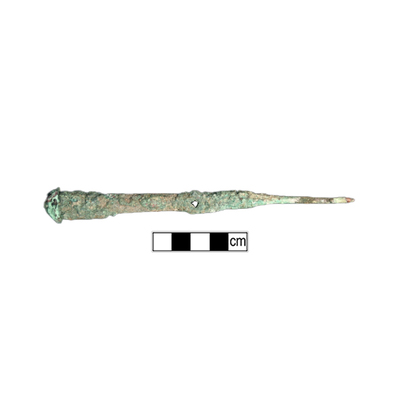
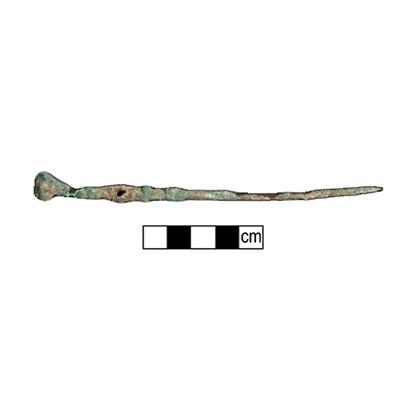
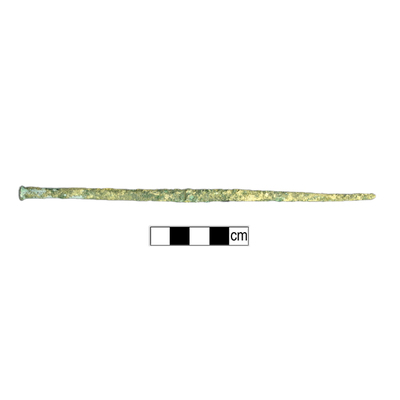
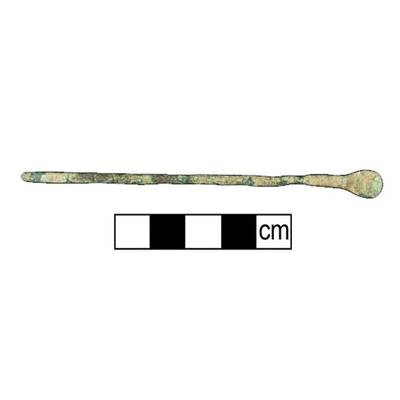
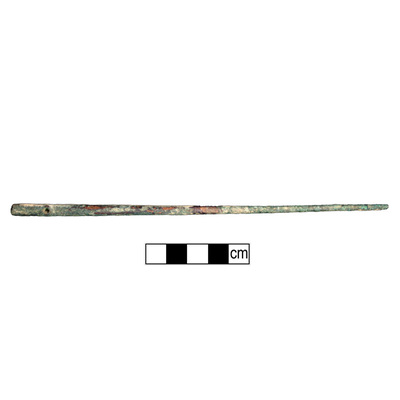
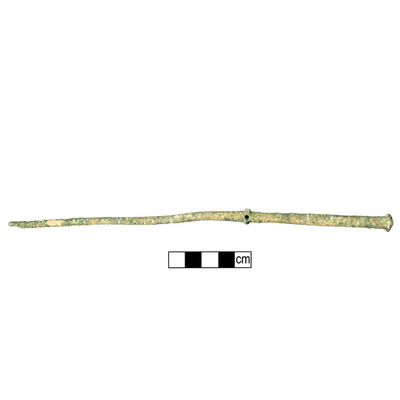
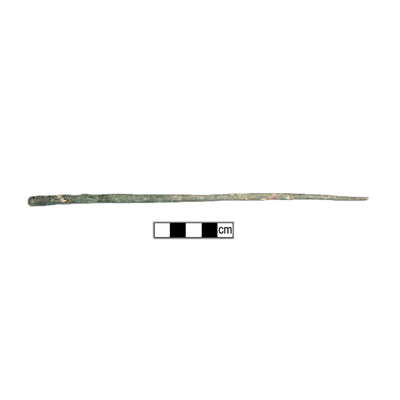
Probe
Unknown
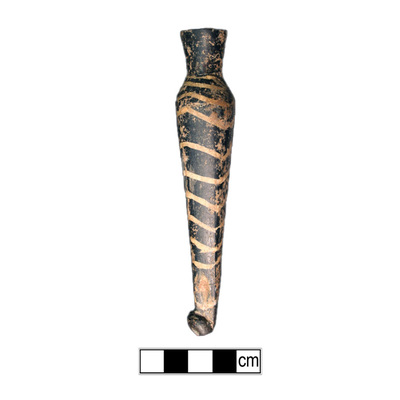
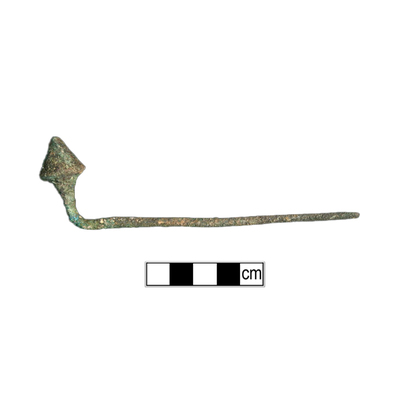
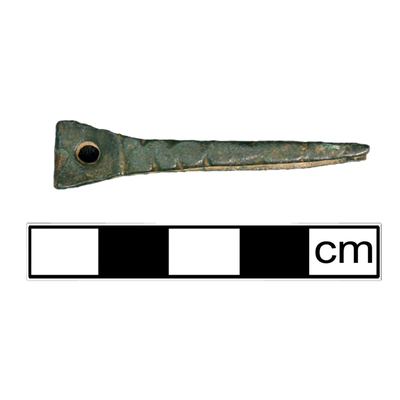
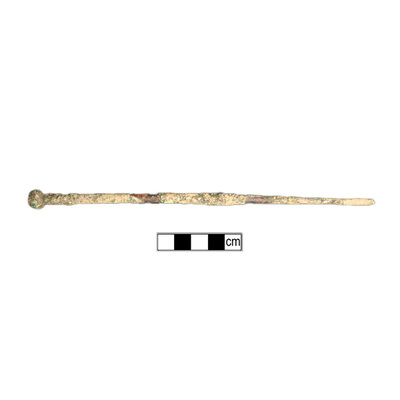
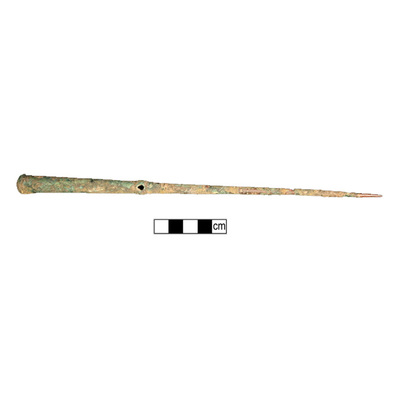
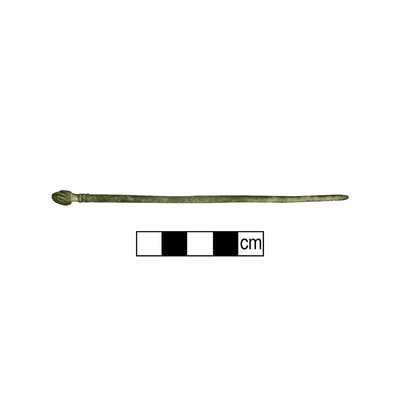
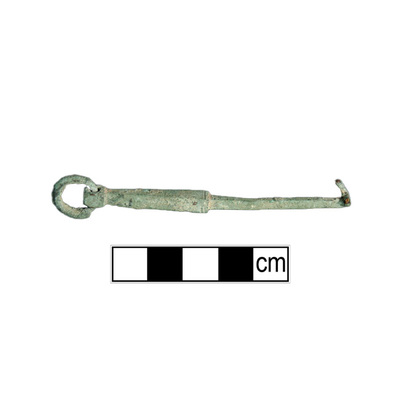
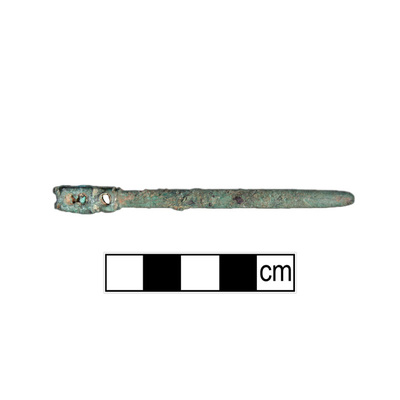
Long, slender, solid object tapers from a rounded flat head to the tip. Tip has been broken away. The top of the bore pierces the shaft 10.7 cm. below the head. A molded collar supports the outside of shaft to the left and the right sides of the bore. The bore is clean and clear of debris.
-
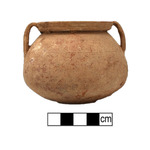
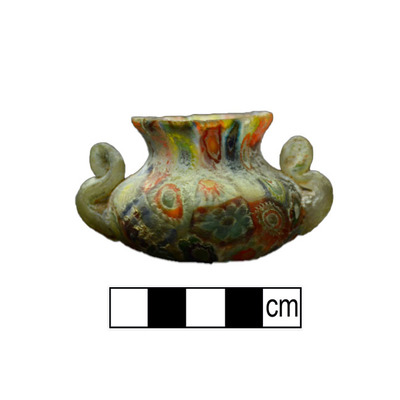
Pyxis
Unknown
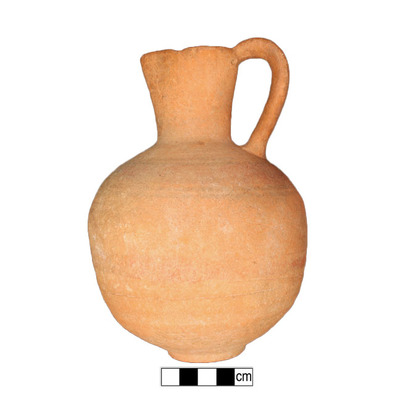
Thin-walled, globular pot has two delicate handles that attach at the rim and at the low shoulder. Lid is missing. Base is a shallow disk trimmed from the object itself. A narrow band is inscribed on the rim below the upper point where the handles meet the rim of the vessel. Another narrow band is inscribed in the body at the lower attachment site for the handle. A small chip in the body creates a hole of 0.15 cm. Traces of the original brick red wash can still be detected.
-
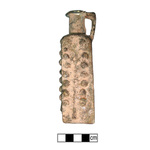
Rectangular bottle
Unknown
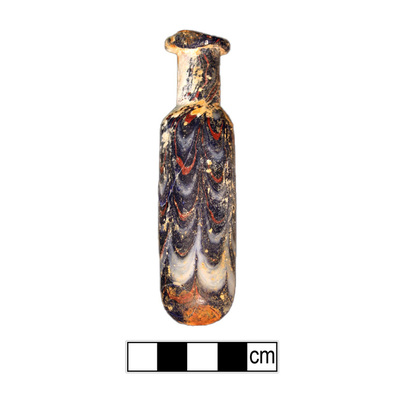
Rectangular body is decorated on three sides with a plant motif in which a central stalk supports fourteen berries arrayed along either side of the stalk. The back side is flat and undecorated. A cylindrical neck rises from the square shoulders and supports a rim which is finished by rolling the edge to the inside. A broad, flat handle attaches to the rim at the undecorated back side and falls at a right angle to reattach just below the shoulder. The pontil mark is evident at the indentation at the base. The bottle is free-standing.
-
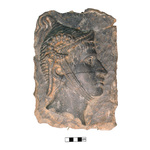
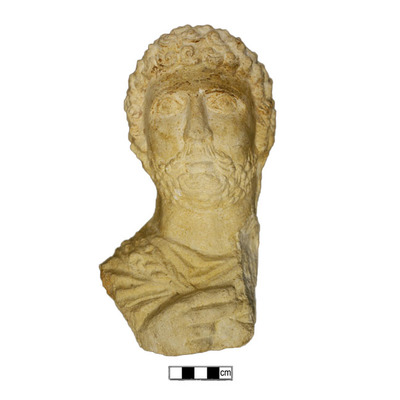
Relief of a soldier
Unknown
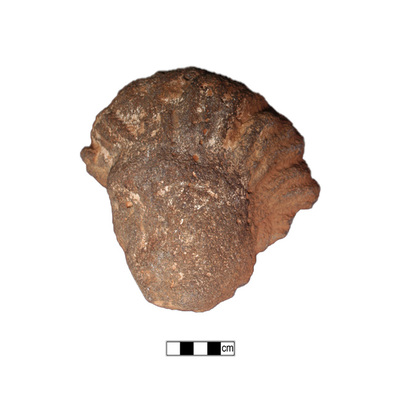
Plaque depicts the head of a soldier in profile. The young man has a well-defined eyebrow and a prominent nose over full lips and a well-defined chin. The neck is strong and unadorned. The hair along the forehead and in front of the ear is portrayed in tufts. On the head is an elaborate helmet with a braided band across the forehead and a chinstrap decorated with a scroll pattern between the braided band and the chin. The strap under the chin is unadorned. The helmet descends in back to cover the nape of the neck. The helmet itself is worked in wavy horizontal rows and adorned with a ram's horn worked in three longitudinal rows of dots; the horn curls out of the braid over the temple and back above the ear. At the crown of the helmet, strands of loose hair flow freely from a funnel of horizontal bands.
-
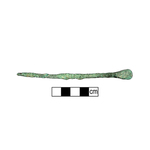
Spathomele
Unknown
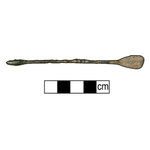
Sturdy object has an unadorned solid cylindrical handle that terminates at one end in a rounded point and at the other end in a flat, teardrop-shaped spatula. One side of the spatula is chipped. The spatula is bent at a gentle angle from the handle.
-
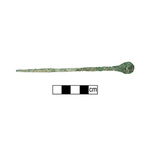
Spathomele
Unknown
Sturdy object has an unadorned solid cylindrical handle that terminates at one end in a rounded point and at the other end in a flat, tear-drop shaped spatula. The spatula is in line with the handle.
-
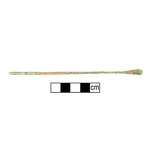
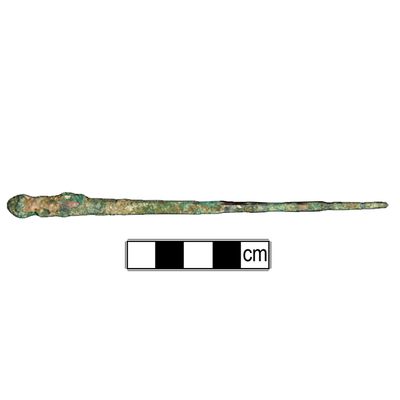
Spathomele
Unknown
Slender tool with a rounded end tapers gently along the solid cylindrical shaft toward the flat blade. The narrow section of the shaft before the blade is embellished with an inscribed line that makes ten turns around the shaft over a distance of 1.8 cm. The tip of the blade is flat, rounded and chipped in two places.
-
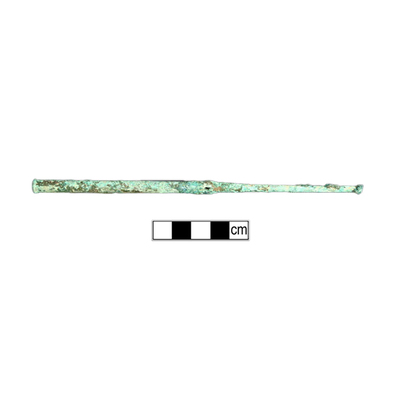
Spathomele
Unknown
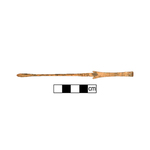
Delicate tool has an olivary point on one end of the solid cylindrical shaft and a flat trapezoidal blade on the other. The fore-edge of the terminal end of the flat blade is straight. Three bands decorate the shaft just above the blade. The blade is embellished with points that curve back toward the shaft for a length of 0.2 cm.
-
Spathomele
Unknown
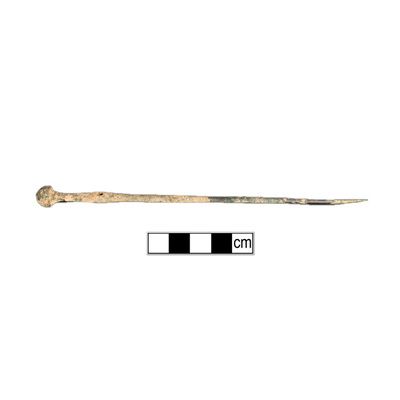
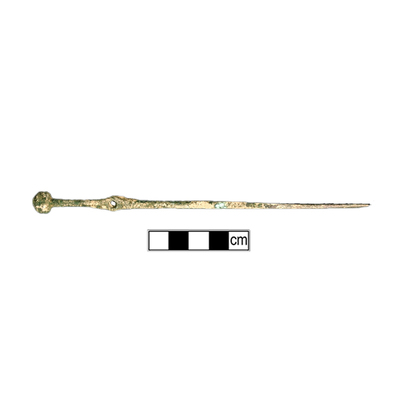
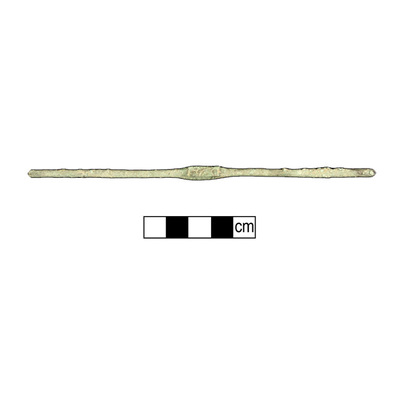
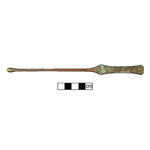
Slender tool with an olivate finial at one end and a trapezoidal blade at the other. The slender shaft is cylindrical and solid. The transition from a cylinder to a flat blade is marked by the edge of the cylinder.
-
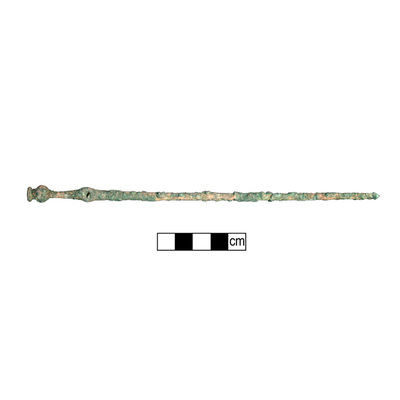
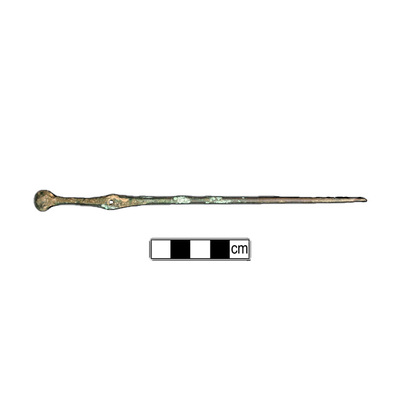
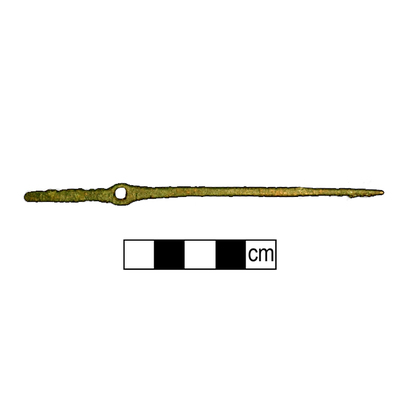
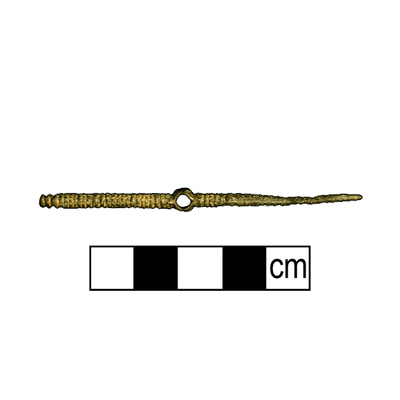
Spatula Probe
Unknown
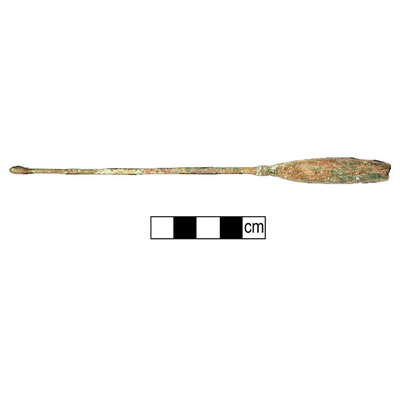
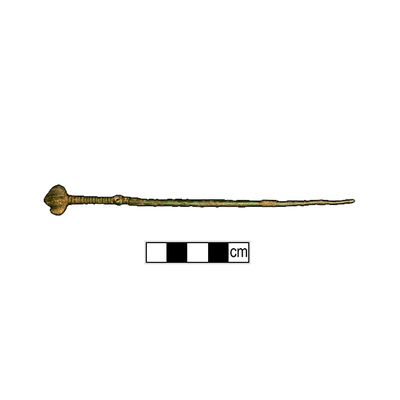
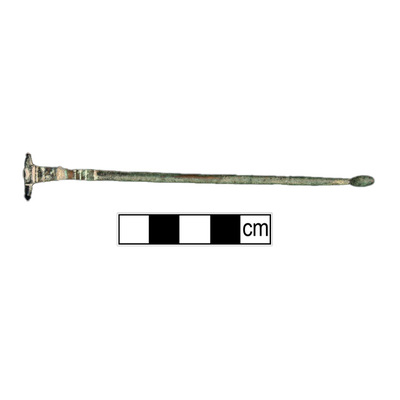
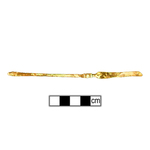
The item was acquired by Dr. Farid Karam in Lebanon. The spatula probe has a flat blade shaped like a lancet, probably due to design but possibly due to wear. The flat blade is attached to a neck with circular cross section that expands into a decorated shoulder before becoming a circular section shaft that terminates in an olivary end.
-
Spoon
Unknown
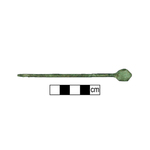
The spoon handle was made by wrapping flat metal back on itself into the shaft. The seam is evident on the back. The shovel is concave in the shape of a shield, terminating along two diagonal straight edges in a point. The left side of the spoon is cracked. The right side of the spoon has broken off and has been smoothed. The depth of the spoon is shallow.
-
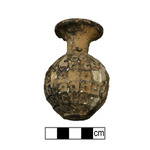
Sprinkler flask
Unknown
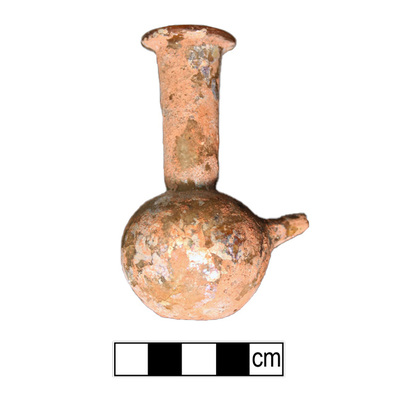
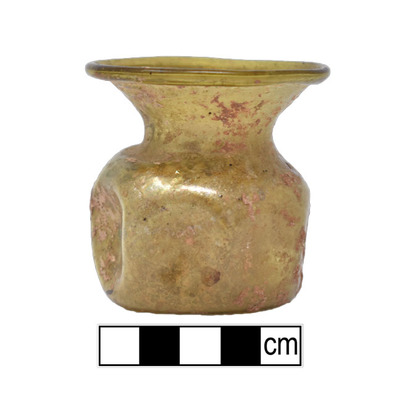
Globular body is attached to a cylindrical neck of 2 cm. diameter. Neck rises 1.7 cm. from the body and then flares out. Rim is triangular. Where the neck meets the body, an aperture of small diameter pierces the throat. The neck seems to be continuous with the body so that the aperture would have been made by folding the neck in upon the top of the globe and then out again. The surface design is a dot-in-square pattern. The vessel is free-standing. There is a small, 0.5 cm. hole in the vessel wall.
-
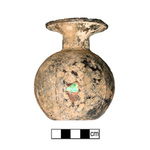
Sprinkler flask
Unknown
Globular body is attached to a cylindrical neck which supports a flared mouth. The rim is folded in evenly. The aperture in the neck occurs midway inside the short neck. The globular body is embellished with nine ribs radiating from the shoulder to the bottom. The bottom is concave with no palpable pontil mark. The bottle is free-standing.
-
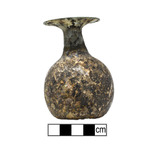
Sprinkler flask
Unknown
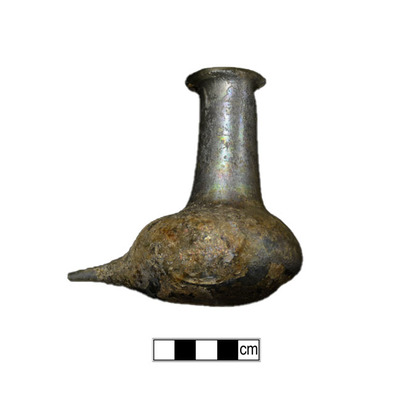
Globular-bodied bottle has a flaring mouth and narrow rim that is flattened and folded under. Aperture inside the neck appears to be formed by folding the neck in above the body and then folding it out again. The neck is cylindrical. Base is concave with no palpable evidence of a pontil mark.
-
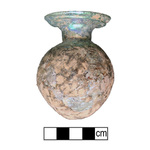
Sprinkler flask
Unknown
Irregularly-shaped globe is attached to a neck of 2.7 cm. diameter which rises 1.5 cm. and then flares out. The rim is folded under and finished with a ridge underneath. Where the neck meets the globe, an aperture of small diameter was created by folding the neck in upon itself. A net pattern was created by blowing the item in a mold. The bottom is rounded.
-
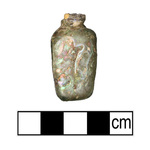
Square bottle
Unknown
Square-shouldered bottle tapers to a smaller 1.6 x 1.7 cm base. A short, round neck sits atop the sloping shoulders. The neck has a visible horizontal gap where the neck has been glued to the bottle. The pitting and color of the neck is dissimilar to that of the body. The vessel rests slightly unevenly on the base and stands askew.
-
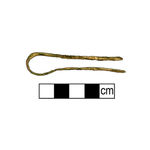
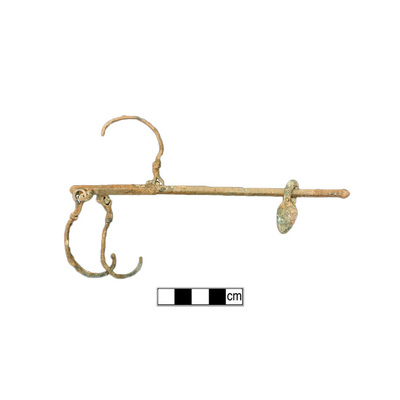
Tweezers
Unknown
The small tool has two flat and broad ends that are rounded and unserrated. One overhangs the other by 0.2 cm. The item is bent at the hinge in a circular shape so that the legs extend parallel to each other. The grip is sufficient for grasping lightweight material.
-
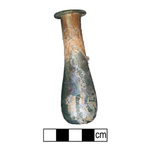
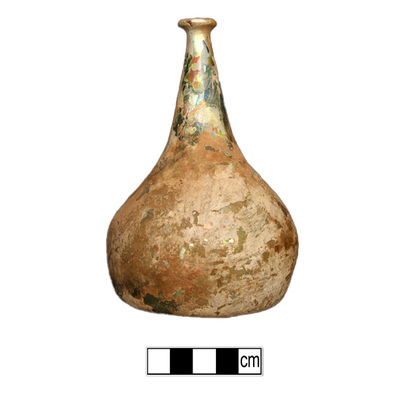
Unguentarium
Unknown
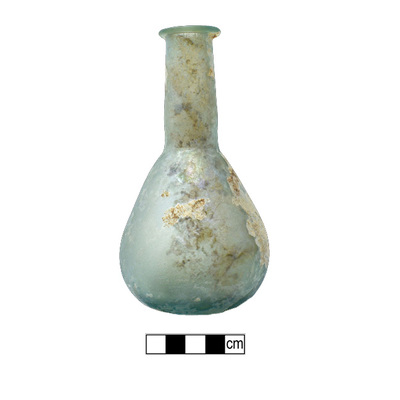
Teardrop-shaped bottle has a flattened bottom with a slight indentation but no palpable pontil mark. The rim is in-folded unevenly and flattened. The cylindrical neck widens to form the body. The neck has been broken and repaired. The diameter of the neck does not fit the diameter of the body at the break site.
-
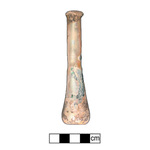
Unguentarium
Unknown
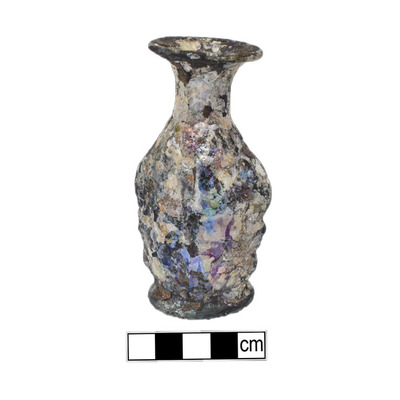
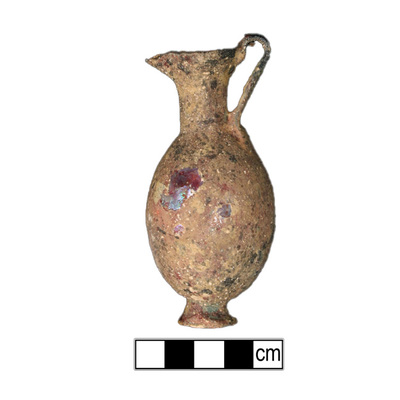
Teardrop-shaped bottle has a narrow ledge rim that is folded inward. The mouth is out-of-round. The base is slighted indented and supports the freestanding vessel. The cylindrical neck is constricted and then widens to create the piriform body.
-
Unguentarium
Unknown
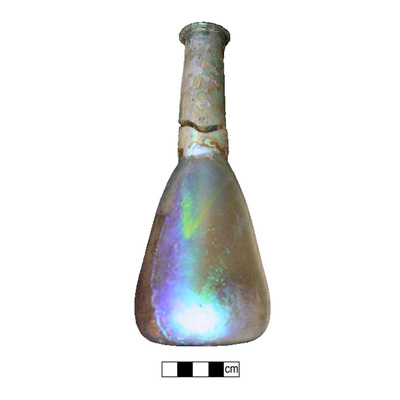
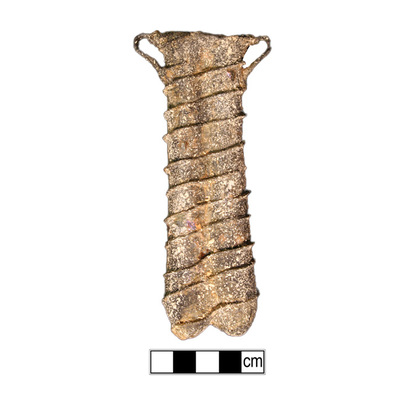
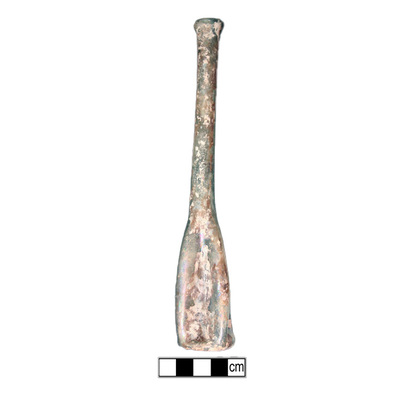
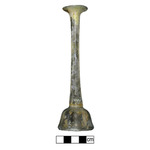
Candlestick-form vessel has a funnel mouth and a simple rim. The long cylindrical neck widens at the base into a bell shape. The base in concave. The object is free-standing. The vessel was broken and repaired at the juncture of the neck and the base.
-
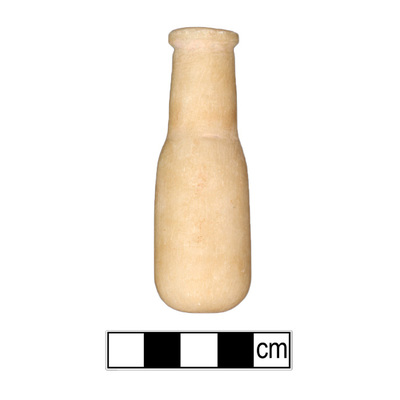
Unguentarium
Unknown
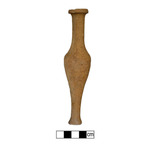
Unglazed bottle has a flat base that narrows before expanding into the body. At the shoulder, the bottle assumes a funnel shape and supports a neck for 4 cm. before flaring to the rim. The rim is finished with a standing collar. The bottle bears whitish residue along one side from foot to rim, indicating that the bottle lay horizontally and partly in the ground. The base is irregular; the bottle cannot stand.
-
Unguentarium
Unknown
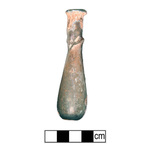
Teardrop-shaped bottle has a twist in the neck that resolves itself 1.9 cm. below the rim. The rim is in-folded and flattened. The bottom is slightly concave; the vessel is not free-standing. The pontil mark is palpable.
-
Unguentarium
Unknown
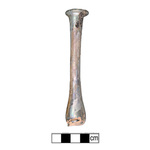
Teardrop-shaped bottle has a prominent pontil mark at the base. The bottle is not free-standing. The rim is flared and in-folded unevenly. The cylindrical neck is constricted before widening into the piriform body.
-
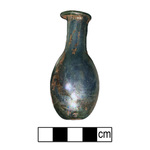
Unguentarium
Unknown
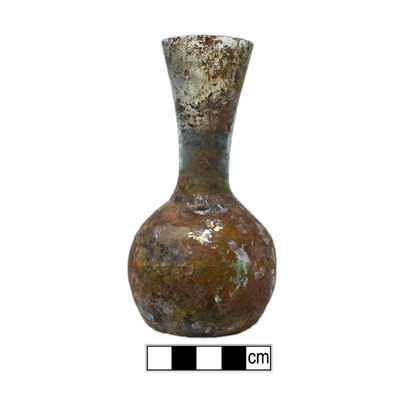
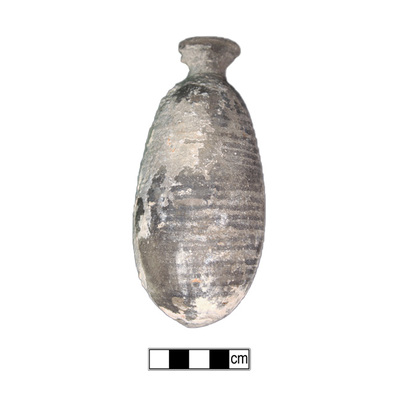
The bottle has an egg-shaped body and a cylindrical neck. The ledge rim is in-folded and flattened so that the depth of the rim is uneven and the ledge is off-center. The bottom is flattened; the object is free-standing. There is no palpable pontil mark. The body of the bottle is not symmetrical.