Art and Art History Collection (Saskia)
Files
Download image (4.4 MB)
Publisher
Saskia, Ltd., Cultural Documentation
Publication Date
January 1966
Time Period
circa 1279–1213 BCE
Abstract
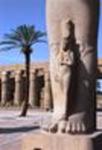
Daughter/wife of Rameses II, at his feet, within the Great Court
Keywords
New Kingdom, Ancient architecture, Temple complexes, Colossi, Statues, Sculpture (visual works)
Alt Text
A large stone statue of a figure with intricate carvings, set against a backdrop of ancient columns and palm trees under a clear sky. The statue's feet are prominently displayed in the foreground.
Extent
1 color photograph
Geographic Location
Egypt; Luxor (Egypt); Karnak Temple Complex (Luxor, Egypt)
Rights
This material is licensed by USF Libraries for the research and teaching needs of USF students, staff, and faculty only. See: https://lib.usf.edu/collections-and-discovery/collection-management/user-terms/
Access Restrictions
Only thumbnail images and descriptive information are available to non-USF users. Full access to this collection is available only to authorized users on the USF network on campus or via VPN.
Media Type
Color photographs
Format
Digital Only
Note
This is a section of a colossal statue of Ramesses II, depicted wearing the nemes headdress and double crown of Upper and Lower Egypt. In the Third Intermediate Period, the monument was usurped by the High Priest of Amun and de facto ruler, Pinedjem I. At his feet is a small royal statue of his daughter/ wife. She could be identified as Queen Nefertari, or Ramsses's daughter Princess Meritamen (Bentanat). Following the usurpation, she was re-designed to represent Maatkare Mutemhat, the High Priestess and daughter of Pinedjem I. In Egyptian art, the scale of figures was directly representational of their status. The Pharaoh or ruler is always rendered as an immense god, whereas royal wives and daughters are more miniature in proportion and placed between the legs to signify their protective but subordinate relationship to the ruler. The massive stone wall behind these structures form part of the Second Pylon, leading directly into the Great Hypostyle Hall.
Identifier
A01-JEA0156
Recommended Citation
Unknown, "Great Forecourt of Karnak Temple Complex, Statue of Ramses II, Detail of Figure at Feet" (1966). Art and Art History Collection (Saskia). 77.
https://digitalcommons.usf.edu/saskia/77