Art and Art History Collection (Saskia)
Alternative Title
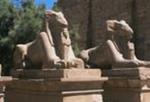
Avenue of Sphinxes
Files
Download image (4.1 MB)
Publisher
Saskia, Ltd., Cultural Documentation
Publication Date
January 1966
Time Period
New Kingdom- Late Period of 30th Dynasty
Abstract
Ram-headed sphinxes of the Processional Way leading into Karnak from west
Keywords
New Kingdom, Ancient architecture, Temple complexes, Pylons (gateway), Sphinxes, Dromoi, Processional ways, Statues, Sculpture (visual works)
Alt Text
Two large stone statues of sphinxes with ram heads and lion bodies are positioned side by side on rectangular pedestals against a brick wall. Trees can be seen in the background under a clear sky.
Extent
1 color photograph
Geographic Location
Egypt; Luxor (Egypt); Karnak Temple Complex (Luxor, Egypt)
Rights
This material is licensed by USF Libraries for the research and teaching needs of USF students, staff, and faculty only. See: https://lib.usf.edu/collections-and-discovery/collection-management/user-terms/
Access Restrictions
Only thumbnail images and descriptive information are available to non-USF users. Full access to this collection is available only to authorized users on the USF network on campus or via VPN.
Media Type
Color photographs
Format
Digital Only
Note
The Temple of Amun-Re is the central structure of the sacred enclosure within the Karnak Temple Complex near Luxor, Egypt. It was dedicated to Amun-Re, chief deity of the Theban Triad, and served as an earthly dwelling for the god. The precinct traces back to the Middle Kingdom (c. 2005-1650 BCE), with simple and modest shrine dedications. Over the next 1,000 years, the New Kingdom (c. 1550-1070 BCE) pharaohs expanded the temple, adding things like pylons, courts, chapels, and hypostyle hall. The main temple is aligned on an east-west axis, with a north-south axis connecting to the Luxor Temple via the Avenue of Sphinxes. Construction on this dromos began in the New Kingdom era and was completed during the Late period of 30th Dynasty ruler Nectanebo I (380-362 BCE). It was then covered by sand for centuries. From 1984 to 2000 CE, the entire route of the walkway was finally determined, leaving it to excavators to uncover the road. The original 1,057 statues are along the way, and they are divided into three shapes. The first is of a lion's body and a ram's head erected on an area of approximately 1,000 feet between the Karnak temple and the Precinct of Mut. The second is a full ram statue, built in a remote area during the 18th Dynasty of Amenhotep III, before being transferred to the Karnak complex. The third, and most common, is a statue of the Sphinx (body of a lion and head of a human), with the statues extending over a mile to Luxor Temple.
Identifier
A01-JEA0154
Recommended Citation
Unknown, "Temple of Amun-Re, Ram-Headed Sphinxes" (1966). Art and Art History Collection (Saskia). 75.
https://digitalcommons.usf.edu/saskia/75