Art and Art History Collection (Saskia)
Files
Download image (3.9 MB)
Publisher
Saskia, Ltd., Cultural Documentation
Publication Date
1966
Time Period
1st century BCE replica of an original from late 4th or early 3rd century BCE
Abstract
Total from center right of one statue
Keywords
Greek Classical period, Sculpture (Visual works), Statues, Bronze, Roman copy, Grand tours, Peristyles (Roman courtyards)
Alt Text
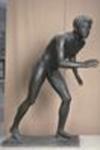
A bronze statue of a young male figure standing on one leg with arms outstretched, displayed against a neutral background. The sculpture captures the figure in a dynamic pose, showcasing detailed musculature and posture.
Extent
1 color photograph
Geographic Location
Italy; Herculaneum (Extinct city); Villa of the Papyri (Herculaneum)
Rights
This material is licensed by USF Libraries for the research and teaching needs of USF students, staff, and faculty only. See: https://lib.usf.edu/collections-and-discovery/collection-management/user-terms/
Access Restrictions
Only thumbnail images and descriptive information are available to non-USF users. Full access to this collection is available only to authorized users on the USF network on campus or via VPN.
Media Type
Color photographs
Format
Digital Only
Note
These sculptures are an identical pair of Roman bronze copies from the 1st century BCE modeled after prior Hellenistic Greek originals often associated with the school of Lysippos. The pair were originally discovered in the 1754 in the peristyle of the Villa of the Papyri in Herculaneum. Depicted are two young, nude athletes leaning forward in a tense starting or stopping pose, indicating a race. Their inlaid eyes are made of bone and stone. They were initially believed to portray wrestlers and were placed facing each other as a result, but after additional studies came out, it was determined they were runners. In ancient Greece, runners competed in the prestigious stadium race during the Olympic Games, with the winners having the honor of naming the Olympiad and lighting the sacred flame. Because the "Runners" captured the ultimate classical aesthetic with their intense, lifelike poses and distinct bone-and-stone eye inlays, they became some of the most sought-after subjects for Grand Tour souvenirs. This object is currently housed at the National Archeological Museum of Naples, Italy.
Identifier
A01-JGC0667
Recommended Citation
Unknown, "Bronze Runners, Detail" (1966). Art and Art History Collection (Saskia). 575.
https://digitalcommons.usf.edu/saskia/575
Book Location
Latitude
40.806667
Longitude
14.345556
Rights Statement