
Art and Art History Collection (Saskia)
Alternative Title
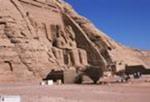
Great Temple of Ramesses II
Files
Download image (4.6 MB)
Publisher
Saskia, Ltd., Cultural Documentation
Publication Date
1966
Time Period
circa 1264-1244 BCE
Abstract
View of rock-cut façade from southeast, moved to higher ground in 1960s
Keywords
New Kingdom, 19th Dynasty, Ancient architecture, Temple complexes, Pschents, Colossi, Statues, Sculptures (Visual works), Sandstone
Alt Text
Ancient rock carvings depicting figures on a large stone surface under a clear blue sky. In the foreground, there are small structures and sparse vegetation.
Extent
1 color photograph
Geographic Location
Egypt; Abu Simbel (Egypt)
Rights
This material is licensed by USF Libraries for the research and teaching needs of USF students, staff, and faculty only. See: https://lib.usf.edu/collections-and-discovery/collection-management/user-terms/
Access Restrictions
Only thumbnail images and descriptive information are available to non-USF users. Full access to this collection is available only to authorized users on the USF network on campus or via VPN.
Media Type
Color photographs
Format
Digital Only
Note
This temple was dedicate to Ra-Harakhte, a falcon-headed sun god of the Ancient Egyptians. This structure was originally carved out of the mountainside's sandstone cliffs. It was included in a larger complex honoring the trinity of Amon-Ra, Ptah, and Ra-Harakhte. The location served as a major religious site for the worship of sun gods. It was commissioned by Pharaoh Rames II and even dedicated to him. The façade includes four colossal statues of the pharaoh and gods wearing the double Atef crown of Upper and Lower Egypt. The exterior of the temple measures 38 meters in length and 31 meters in height. The statues are 20 meters in height each. The purpose of the temple was to project Egyptian power to their enemies in Nubia, as well as a dedication to the gods. Twice a year, February 22 and October 22, sunlight illuminates the sanctuary and shines upon three of the four statues, leaving Ptah in darkness. In the 1960s, rising water from the Aswan High Dam threatened the survival of the site. An international salvation effort was put in place, and the temple was cut into blocks so it could be relocated to higher ground, completed in 1968. It is now located on the western shore of Lake Nasser in the Aswan Governorate, 60 meters above where it was previously located.
Identifier
A01-JEA0007
Recommended Citation
Unknown, "Temple of Ra-Harakhte, Exterior, B" (1966). Art and Art History Collection (Saskia). 34.
https://digitalcommons.usf.edu/saskia/34
Book Location
Latitude
22.3488543164627
Longitude
31.596728099538
Rights Statement