Art and Art History Collection (Saskia)
Files
Download image (3.9 MB)
Publisher
Saskia, Ltd., Cultural Documentation
Publication Date
1966
Time Period
222-235 CE replica of an original from late 2nd century BCE
Abstract
Front center
Keywords
Greek Hellenistic period, Severan period, Sculpture (Visual works), Roman copy
Alt Text
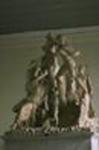
A marble sculpture depicting multiple human figures in dynamic poses, mounted on a pedestal. The figures are intricately detailed and appear to be engaged in an intense scene.
Extent
1 color photograph
Geographic Location
Italy; Rome (Italy); Terme di Caracalla (Rome, Italy)
Rights
This material is licensed by USF Libraries for the research and teaching needs of USF students, staff, and faculty only. See: https://lib.usf.edu/collections-and-discovery/collection-management/user-terms/
Access Restrictions
Only thumbnail images and descriptive information are available to non-USF users. Full access to this collection is available only to authorized users on the USF network on campus or via VPN.
Media Type
Color photographs
Format
Digital Only
Note
This sculpture is a massive and detailed Roman copy of a Greek Hellenistic creation. It is the largest single sculpture currently recovered from antiquity. Unearthed in 1546, the Farnese Bull was found amongst excavations at the gymnasium of the Roman Baths of Caracalla. The statue has been restored and even includes elements around the base that may not have been in the original composition. It underwent substantial reconstruction in the sixteenth century when Michelangelo planned to utilize it for a fountain in the center of a garden between Palazzo Farnese and the Villa Farnesia. Further restorations were made in the eighteenth and nineteenth centuries. The scene shows an event in Classical Greek mythology where Dirce, first wife of King of Thebes, is being killed. She was tied to a wild bull by the sons of Antiope, Amphion and Zethus, who wanted to punish Dirce for ill-treatment she inflicted on their mother. It is part of the Farnese Collection at the Naples National Archaeological Museum, Italy, though in recent years, it has been displayed at the National Museum of Capodimonte across the city.
Identifier
A01-JGC0219
Recommended Citation
Unknown, "Farnese Bull, A" (1966). Art and Art History Collection (Saskia). 273.
https://digitalcommons.usf.edu/saskia/273
Book Location
Latitude
41.879035227166
Longitude
12.4924253169322
Rights Statement