Art and Art History Collection (Saskia)
Files
Download image (3.5 MB)
Publisher
Saskia, Ltd., Cultural Documentation
Publication Date
1966
Time Period
1st century CE replica of an original from 440 BCE
Abstract
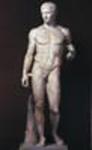
Total view of sculpture from front center, featured is the spear-bearer Doryphoros
Keywords
Greek Classical period, Sculpture (Visual works), Statues, Roman copy, Contrapposto
Alt Text
A statue of a muscular, nude male figure standing on a pedestal with one arm bent and the other relaxed by his side. The statue has a weathered, aged appearance against a dark background.
Extent
1 color photograph
Geographic Location
Italy; Pompeii (Extinct city); Samnite Palaestra (Pompeii, Italy)
Rights
This material is licensed by USF Libraries for the research and teaching needs of USF students, staff, and faculty only. See: https://lib.usf.edu/collections-and-discovery/collection-management/user-terms/
Access Restrictions
Only thumbnail images and descriptive information are available to non-USF users. Full access to this collection is available only to authorized users on the USF network on campus or via VPN.
Media Type
Color photographs
Format
Digital Only
Note
The Doryphoros was a notable sculpture by Polykleitos, though the Greek bronze original is lost, so it is only known for later Roman copies. This copy was excavated in Pompeii in 1797 in front of the entrance to the Samnite Palaestra. The work is an early example of contrapposto and classical realism. Distinct proportions were utilized in creation, with the ratio of head to body at one to seven. The head of the figure is slightly turned to the right, with a heavily muscled and athletic build. The posture features Doryphoros taking a slight step forward, shifting his weight. The right leg is straightened, supporting the body weight, with the right hip raised and right torso contracted. The left leg bears no weight and his left hip drops. The left hand would have originally held a spear and rested on his shoulder. The right arm hangs positioned at the subject's side, perhaps the earliest extant example of a free-hanging arm in a statue. A large, sculpted tree stump is added behind his right leg to support the weight of the marble stone, but would not have been present in the original as bronze does not require this reinforcement. It now resides in the Naples National Archaeological Museum, Italy.
Identifier
A01-JGC0185
Recommended Citation
Unknown, "Doryphoros, Roman Copy" (1966). Art and Art History Collection (Saskia). 235.
https://digitalcommons.usf.edu/saskia/235
Book Location
Latitude
40.7490451399
Longitude
14.487942161
Rights Statement