Art and Art History Collection (Saskia)
Files
Download image (4.2 MB)
Publisher
Saskia, Ltd., Cultural Documentation
Publication Date
1966
Time Period
circa 444-440 BCE
Abstract
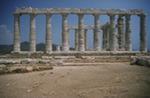
General view of the Temple from south view
Keywords
Greek Classical period, Temple Complex, Doric Columns, Doric (Architectural style), Periboloi, Porticoes, Propylaea, Stoas
Alt Text
Ancient stone columns stand in a row against a clear blue sky, with mountains visible in the background and a rocky ground in the foreground. The structure appears partially ruined, with some columns missing or damaged.
Extent
1 color photograph
Geographic Location
Greece; Sounias (Greece)
Rights
This material is licensed by USF Libraries for the research and teaching needs of USF students, staff, and faculty only. See: https://lib.usf.edu/collections-and-discovery/collection-management/user-terms/
Access Restrictions
Only thumbnail images and descriptive information are available to non-USF users. Full access to this collection is available only to authorized users on the USF network on campus or via VPN.
Media Type
Color photographs
Format
Digital Only
Note
The Temple of Poseidon at Sounion is a doric-style ancient Greek temple at the southernmost tip of Attica. This site has sacred significance since the Bronze Age, with earlier temples dating to the Archaic period. The current temple was constructed on the ruins of an earlier porous-stone temple that was destroyed by the Persians in 490 BCE. It was built as part of Athens' Golden Age building program, with another example being the Parthenon. The temple was dedicated to the Greek god Poseidon of the sea. Due to the importance of naval occupation and trade, the sea was an important part of Athenian culture that they revered. One reason for the construction of the temple may have been for military purposes due to its strategic location. The material and size of the offerings found here indicate that it was likely frequented by elite members as well as those part of the aristocratic class. This temple was secured by its own peribolos, propylaea, and two stoas. At least forty-one column limestone drums have been identified, with several of them containing cuttings that are diverse in their size.
Identifier
A01-JGA0105
Recommended Citation
Unknown, "Temple of Poseidon, D" (1966). Art and Art History Collection (Saskia). 204.
https://digitalcommons.usf.edu/saskia/204
Book Location
Latitude
37.6503241135938
Longitude
24.0254143234579
Rights Statement