The Florida Center for Emergency Medical Services (FL-CEMS) was established in 2024 through a CDC grant through the Florida Department of Health and is housed at the University of South Florida’s Morsani College of Medicine in downtown Tampa. The Center brings together experts to improve EMS education, system performance, disaster response, and patient care across Florida.
This page serves as a central repository for FL-CEMS research reports. Here you’ll find data-driven studies and policy briefs on EMS workforce trends, system design, clinical innovation, and more. These reports support EMS leaders, policymakers, and educators in building a stronger, more effective EMS system.
-
Policy Brief for Crisis on the Frontlines: Recruitment and Retention Challenges in EMS
Florida Center for Emergency Medical Services
Executive Summary
Emergency Medical Services (EMS) in Florida and across the United States are facing an unprecedented workforce crisis. EMS staffing shortages are no longer looming - they are present-day realities that affect the safety and well-being of every community. EMS personnel are the first line of response for medical emergencies, disasters, and public health crises. Yet today, many agencies are struggling to maintain staffing levels due to recruitment barriers, retention challenges, and systemic funding shortfalls. The message is clear: stabilizing the EMS workforce is essential not only for EMS agencies but also for the broader public safety and health infrastructure.
-
Policy Brief for Evidence-Based Telehealth Use in EMS: A Comprehensive Reference for Program Administrators, Field Leaders, and Clinical Directors
Florida Center for Emergency Medical Services
Executive Summary
Telehealth-supported emergency medical services (EMS) represents an evidence- based approach to enhancing prehospital care delivery, expanding access to physician expertise, and improving resource utilization. The evidence base demonstrates clear benefits in appropriate contexts: for time-sensitive emergencies, telehealth enables significant reductions in treatment times; for low-acuity conditions, programs report transport reductions of 50–67% while maintaining high safety profiles.
Successful implementation requires appropriate patient selection, robust technical infrastructure, comprehensive training, and systematic quality assurance. Programs demonstrate success when targeting patients with stable vital signs and absence of conditions requiring immediate physical intervention. Implementation barriers commonly include regulatory and reimbursement limitations, clinician acceptance concerns, and technical infrastructure challenges.
Telehealth holds particular promise for rural and underserved areas, enabling centralized physician expertise to support distributed units and mitigating workforce shortages. A measured approach beginning with limited scope and expanding based on demonstrated success achieves better outcomes than comprehensive implementation from the outset.
-
Policy Brief for Florida EMS Voices: What Agency Providers Told Us in 2025
Florida Center for Emergency Medical Services
Executive Summary
The 2025 Annual Florida EMS Provider Survey provides a comprehensive overview of Florida's EMS system, covering workforce dynamics, resource allocation, medical direction, mental health programming, mobile integrated healthcare, and disaster preparedness. Conducted from April to May 2025, the survey reveals both system strengths and critical gaps requiring attention.
Key findings highlight regional variability across nearly all domains. While EMT positions remain relatively stable, persistent paramedic vacancies continue to challenge agencies statewide. Mental health and wellness programs are widespread but inconsistently implemented. Mobile Integrated Healthcare programs show promise but face funding sustainability challenges. Salary disparities across regions and experience levels suggest opportunities for statewide benchmarking.
Overall, the survey identifies critical points of strength, including strong adoption of core clinical protocols and high engagement in mental health programming, alongside clear areas for improvement in workforce development, inter-agency coordination, and public health integration.
-
Policy Brief for Integrated Perspectives: Florida EMS Workforce and Agency Synthesis 2025
Florida Center for Emergency Medical Services
Executive Summary
Workforce shortages persist. Paramedic vacancies remain widespread across Florida, with a median of two open positions per agency. Clinicians cite dissatisfaction with pay as the most significant retention concern, with compensation receiving the lowest satisfaction rating among all employment domains.
Recruitment pipelines are growing. Agencies report active investment in cadet programs (42 agencies), explorer programs (31 agencies), and high school EMS academy partnerships (24 agencies). However, clinicians emphasize that systemic barriers including low entry-level pay and limited advancement opportunities constrain the long-term effectiveness of these efforts.
Wellness programs are underutilized. A significant gap exists between agency- reported program availability and clinician awareness. For example, 74% of agencies report offering Employee Assistance Programs, but only 52% of clinicians are aware of such services. Similar gaps exist for peer support, psychological first aid, and chaplaincy services.
Training outcomes vary by region. EMT first-attempt pass rates (69.0%) approximate national norms, while paramedic pass rates (59.6%) lag behind, with sharp regional disparities. Region 2 achieved the highest paramedic pass rate (86.7%), while Regions 3 and 7 fell below 53%.
Telehealth adoption is limited but supported. Nearly three-quarters of clinicians expressed willingness to participate in alternate-destination or community paramedicine programs. However, agency adoption remains concentrated in larger, urban systems, with rural agencies citing funding, staffing, and regulatory barriers.
-
Policy Brief for Training the Lifeline: Florida EMS NREMT Performance and Program Quality
Florida Center for Emergency Medical Services
Executive Summary
Florida's emergency medical services system depends on a reliable pipeline of well- trained EMTs and paramedics. National Registry of Emergency Medical Technicians (NREMT) first-attempt pass rates serve as a critical benchmark for program quality and workforce readiness. Florida has consistently underperformed relative to national averages, particularly at the paramedic level, raising concerns about the quality and consistency of EMS education statewide and its implications for workforce readiness and public safety.
In 2024, Florida's paramedic programs achieved a 59.9% first-attempt pass rate, nearly 18 percentage points below the national average of 77.9%. This gap represents more than a testing outcome. It reflects potential weaknesses in educational quality that directly affect the state's capacity to staff ambulances, respond to emergencies, and deliver prehospital care. While some training organizations in Florida exceed the national average, the majority fall significantly below it, suggesting that program-level characteristics may influence outcomes.
-
Policy Brief for Vital Signs: Findings from Florida’s 2024 EMS Workforce Statewide Survey
Florida Center for Emergency Medical Services
Executive Summary
Florida's Emergency Medical Services workforce stands at a critical juncture. The 2024 statewide survey of nearly 50,000 certified EMTs and paramedics reveals both strengths and vulnerabilities that demand immediate policy attention. While Florida's EMS professionals demonstrate strong commitment to their communities and confidence in clinical leadership, significant challenges threaten long-term workforce sustainability.
Most concerning are persistent gaps in compensation satisfaction, high rates of mental health challenges, and troubling retention patterns among early-career providers. These findings suggest that without strategic intervention, Florida may face escalating shortages in emergency medical response capacity, particularly in underserved and rural communities.
This policy brief synthesizes key findings and presents evidence-based strategies to strengthen workforce recruitment, retention, and wellness. The recommendations are grounded in data from 49,200 survey responses and aligned with national best practices. Success will require coordinated action from state agencies, local governments, EMS employers, and educational institutions.
-

Evidence-Based Telehealth Use in EMS: A Comprehensive Reference for Program Administrators, Field Leaders, and Clinical Directors
Michael Lozano Jr.
Executive Summary
Telehealth-supported emergency medical services (EMS) represents an evidence-based approach to enhancing prehospital care delivery, expanding access to physician expertise, and improving resource utilization. This best-practice reference synthesizes current evidence and operational experience to guide EMS administrators in evaluating, implementing, and sustaining telehealth programs tailored to their communities' needs and resources.
Telehealth in EMS encompasses multiple distinct applications. General teleconsultation enables paramedics to connect with remote emergency physicians for real-time clinical guidance and disposition decisions. Specialty-specific applications focus on time-sensitive conditions including stroke and acute myocardial infarction, where early specialist involvement compresses treatment timelines. Community paramedicine integration extends EMS capabilities to chronic disease management and preventive care. Mental health applications provide crisis triage and specialist consultation for behavioral emergencies.
The evidence base demonstrates clear benefits in appropriate contexts. For time-sensitive emergencies, telehealth enables significant reductions in treatment times, with documented improvements in door-to-needle times for stroke and time-to-reperfusion for myocardial infarction. For low-acuity conditions suitable for alternative disposition, programs report transport reductions of 50-67% while maintaining high safety profiles. Economic evaluations demonstrate substantial cost savings in well-designed programs, with reported annual savings approaching $1 million and per-case cost reductions of approximately 50%. Quality metrics show diagnostic accuracy comparable to in-person evaluation, improved guideline adherence, and low adverse event rates.
Successful implementation requires appropriate patient selection, robust technical infrastructure, comprehensive training, and systematic quality assurance. Programs demonstrate success when targeting patients with stable vital signs and absence of conditions requiring immediate physical intervention. Essential components include HIPAA- compliant platforms with real-time vital signs transmission, qualified physicians providing teleconsultation, integration with existing EMS workflows, and comprehensive training for field personnel and remote physicians. Medical director engagement is critical for protocol development, quality oversight, and clinical direction.
Implementation barriers commonly include regulatory and reimbursement limitations, clinician acceptance concerns, and technical infrastructure challenges. Effective mitigation strategies emphasize phased implementation beginning with pilot testing, early stakeholder engagement, structured training programs, redundant communication systems, and participation in alternative payment models. Financial sustainability requires rigorous program evaluation, systematic documentation of outcomes and cost impacts, and engagement with payers to support value-based reimbursement.
Much of the strongest evidence originates from international implementations operating under different practice models than U.S. EMS. However, core principles including robust infrastructure, systematic quality monitoring, comprehensive training, and careful patient selection translate directly across systems. The key is thoughtful adaptation rather than direct replication. Telehealth holds particular promise for rural and underserved areas, enabling centralized physician expertise to support distributed units and mitigating workforce shortages.
Successful telehealth-supported EMS emerges from deliberate planning, systematic implementation, ongoing quality monitoring, and continuous adaptation to local contexts. A measured approach beginning with limited scope and expanding based on demonstrated success achieves better outcomes than comprehensive implementation from the outset. EMS administrators willing to invest in systematic implementation can expect meaningful improvements in care delivery and operational efficiency.
-
Training the Lifeline: Florida EMS NREMT Performance Review 2024
Michael Lozano Jr. and Farina Klocksieben
Executive Summary
Florida EMS Training Program Performance: 2025 Report on NREMT Outcomes
Why It Matters
Florida’s EMS system depends on a pipeline of well-prepared EMTs and Paramedics. NREMT
first-attempt pass rates are used as a national benchmark. Florida has long trailed national
averages, especially for paramedics, raising concerns about workforce readiness and public
safety.Key Findings
EMT Programs (58 programs, 4,773 candidates in the 2024 cohort)
- 69.2% statewide pass rate (3,305 passed).
- Region 2 highest at 80.8%; Region 6 lowest at 63.9%.
- Slightly above the 3-year national average (67%) but below the 2024 national rate
(77.0%).
Paramedic Programs (44 programs, 1,827 candidates in the 2024 cohort)
- 59.9% statewide pass rate (1,094 passed).
- Region 2 highest at 86.7%; Regions 3 & 7 lowest at ~53%.
- Nearly 18 percentage points below the national 2024 average (77.9%).
- No program structural features (e.g., hours, rotations, director credentials) predicted
outcomes.
Accreditation
- CAAHEP-accredited programs: 63.8% pass rate.
- Non-accredited: 49.6% pass rate.
- Accreditation is the only consistent predictor of higher outcomes.
Weighted Averages
- More accurate measure than simple averages.
- Adjusts for program size, preventing small outliers from skewing statewide results.
- 2024 weighted averages: EMT 77.4%, Paramedic 77.9% - closer to national
performance benchmark.
Implications for Florida EMS
- Paramedic outcomes are the critical gap: Statewide performance trails national
levels by nearly 20%. - Accreditation matters: Strong association with higher pass rates; should be a focus
for policy and regulatory strategies. - Structural measures are weak predictors: Program features such as hours,
hospital/agency rotations, or medical director credentials did not explain outcome
differences. - Instructional quality and support likely matter more: Faculty preparation,
curriculum design, and student readiness may drive success. These factors should be
measured.
Strategic Priorities
- Support underperforming Paramedic programs, especially in Regions 3 and 7.
- Expand accreditation and strengthen requirements or incentives for CAAHEP
accreditation. - Shift focus from structure to quality to invest in instructional improvement,
simulation, and student support. - Consider using weighted averages in reporting for statewide performance tracking.
Bottom Line: Florida’s EMT training is improving but still trails national benchmarks, while
paramedic performance remains a critical weakness. Accreditation and instructional quality,
not structural program features, are the levers most likely to improve outcomes and
strengthen Florida’s EMS workforce pipeline. -
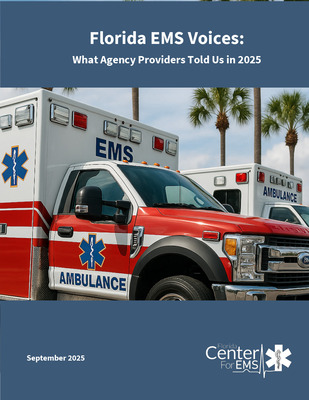
Florida EMS Voices: What Agency Providers Told Us in 2025
Michael Lozano
The 2025 Annual Florida EMS Provider Survey provides a comprehensive overview of Florida’s EMS system, highlighting critical insights into workforce dynamics, resource allocation, medical direction, and service integration across EMS agencies statewide. Conducted from April to May 2025, the survey received robust participation from 249 agencies, covering 74.5% of licensed EMS providers. Key findings underscore regional variability in workforce recruitment, salary scales, mental health support, mobile integrated healthcare (MIH), and preparedness for mass casualty incidents.
Key areas of strategic emphasis include EMT and paramedic mental health and wellness, mobile integrated healthcare (MIH), and local quality improvement (QI) efforts. Notably, recruitment efforts targeting youth and structured retention strategies appear widespread but inconsistently implemented. EMS workforce analyses reveal a stable EMT workforce contrasted by persistent paramedic vacancies, highlighting areas requiring targeted workforce development interventions. Salary disparities across regions and experience levels also suggest opportunities for statewide salary benchmarking and policy adjustments.
EMS agencies demonstrate active engagement in mental health programming, with significant efforts towards resiliency and behavioral health initiatives, although gaps remain in resource consistency and sufficiency. MIH programs, widely present, show promise in addressing social determinants of health, but funding sustainability and inter-agency collaboration require further development.
Overall, the survey identifies critical points of strength and clear areas for improvement, providing foundational data to inform state EMS planning, resource allocation, and strategic policy decisions aimed at enhancing Florida’s prehospital EMS system.
-
Integrated Perspectives: Florida EMS Workforce and Agency Synthesis 2025
Michael Lozano
The Florida Center for Emergency Medical Services (FL-CEMS) integrated findings from the 2024 EMT and Paramedic Renewal Survey (49,200 clinicians), the 2025 EMS Provider Survey (260 agencies), and 2024 NREMT Cognitive & Certification exam outcomes to provide a comprehensive picture of Florida’s EMS workforce and training environment.
-
Vital Signs: Findings from Florida’s 2024 EMS Workforce Statewide Survey
Michael Lozano, Bruce J. Moeller, and Ashley Tobin
The 2024 EMT and Paramedic License Renewal Survey provides a comprehensive analysis of workforce trends, employment characteristics, recruitment challenges, retention patterns, and the mental health and wellness of emergency medical personnel in Florida. Conducted by the Florida Center for Emergency Medical Services (FL-CEMS) in collaboration with the Bureau of Emergency Medical Oversight (BEMO) at the Florida Department of Health (DoH), this survey captures insights from thousands of EMTs and paramedics renewing their professional licenses.
Key findings indicate persistent challenges in workforce retention, particularly for early-career professionals, and a notable decline in satisfaction with compensation. Despite these concerns, EMS personnel express high confidence in medical direction and work schedule flexibility, suggesting that operational support remains strong. The survey also reveals meaningful differences in satisfaction across agency types and community settings, with fire-based EMS agencies demonstrating the highest overall approval ratings. Mental health and wellness assessments indicate a significant symptom burden among EMS professionals, underscoring the need for expanded psychological support systems. Additionally, attitudes toward Mobile Integrated Health (MIH) programs and telehealth suggest growing interest in alternative EMS deployment strategies, though barriers to participation remain.
The findings of this survey provide actionable insights for policymakers, EMS agency leaders, and educators to enhance workforce sustainability, improve job satisfaction, and support professional development initiatives that address emerging trends in emergency medical services.
-

Crisis on the Frontlines: Recruitment and Retention Challenges in EMS
Bruce J. Moeller and Michael Lozano
Florida’s emergency medical services (EMS) and fire service agencies face an unprecedented workforce crisis. Compounded by demographic shifts, rising call volumes, and mounting mental health challenges, many EMS agencies are struggling to recruit and retain qualified personnel. Existing models of recruitment—centered on short-term bonuses or messaging emphasizing sacrifice—are failing to resonate with new generations of workers, who prioritize mental wellness, career progression, and work-life balance. Additionally, outdated training pipelines and a decline in volunteerism, especially in rural areas, have weakened the traditional workforce structure, creating gaps that threaten the stability of emergency response systems statewide.
To address these challenges, the report highlights opportunities for strategic, evidence-based reforms to help stabilize and modernize the EMS workforce. These opportunities include expanding access to scholarships and paid training, establishing career ladders and leadership development pathways, and creating a positive, supportive workplace culture to combat burnout and improve job satisfaction. Strengthening onboarding, mentorship, and employee engagement, along with robust data monitoring and evaluation, are essential to ensure these initiatives deliver measurable results. Investing in a resilient, well-prepared EMS workforce is not just an operational imperative—it is a public safety priority that demands coordinated policy and leadership action.