Art and Art History Collection (Saskia)
Files
Download image (4.0 MB)
Publisher
Saskia, Ltd., Cultural Documentation
Publication Date
1966
Time Period
1st or 2nd century CE replica of an original from 3rd century BCE
Abstract
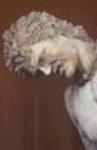
Detail of head from right front
Keywords
Greek Hellenistic period, Sculpture (Visual works), Statues, Roman copy, Celtic (Culture or style), Gallic
Alt Text
A marble statue depicting a figure with curly hair and a serene expression, partially draped in cloth. The sculpture captures intricate details of the face and upper body against a plain background.
Extent
1 color photograph
Geographic Location
Italy; Rome (Italy); Gardens of Sallust (Rome, Italy)
Rights
This material is licensed by USF Libraries for the research and teaching needs of USF students, staff, and faculty only. See: https://lib.usf.edu/collections-and-discovery/collection-management/user-terms/
Access Restrictions
Only thumbnail images and descriptive information are available to non-USF users. Full access to this collection is available only to authorized users on the USF network on campus or via VPN.
Media Type
Color photographs
Format
Digital Only
Note
This is thought to be a Roman marble copy from the 1st century CE after a lost Greek bronze original, likely commissioned around 230-220 BCE by King Attalus I of Pergamon to celebrate a military victory over the Galatians. Discovered in the early 17th century during the excavations at the ancient Gardens of Sallust for the building of the Villa Ludovisi, commissioned by Cardinal Ludovico Ludovisi on the Pincian Hill. It serves as a prime example of the Hellenistic art style, with preferred emotional intensity, realism, and even heroic suffering. Depicted is a fatally wounded Gallic warrior from a Celtic tribe, seated on his oval shield. He is wearing a Celtic twisted neck ring called a torc. Hair is rendered in a coarse and chunky way, as well as his mustache, matching ancient Greek and Roman depictions of Northern European tribes. There is a gash on his right side, in the center of his torso, with the marble rendered as blood dripping down the body. A curved trumpet and broken sword lie on the ground around him. This object is currently housed at the Capitoline Museum in Rome, Italy.
Identifier
A01-JGC0707
Recommended Citation
Unknown, "Dying Gaul, Detail" (1966). Art and Art History Collection (Saskia). 590.
https://digitalcommons.usf.edu/saskia/590
Book Location
Latitude
41.90808
Longitude
12.49692
Rights Statement